Guides
How a talent management agency business tracks cash flow week to week in 2027
A talent management agency tracks weekly cash flow in 2027 with dated commission receipts, draw schedules, and a rolling thirteen-week forecast.
What to take away
- A talent management agency books commission income on the date the brand pays, not the date the deal was signed or the invoice went out.
- Track cash flow week to week with a thirteen-week rolling forecast, and update the actual column every Monday before you project the next week.
- Keep a separate draw schedule for talent advances, because that money leaves before the brand pays.
- Name one owner for each cost line, so a missed payment has a person attached to it.
- Reconcile the bank balance to the forecast monthly, and treat any gap over your own stated tolerance as a stop-and-check.
- Put the 2027 dates that move cash on the same calendar as the weekly forecast.
This article covers general agency operations. It does not cover individualized talent-agency licensing, fiduciary, tax, or employment advice. It also does not cover contract or legal advice.
Rules vary by state and by union. Confirm specifics with the California Labor Commissioner, your state licensing authority, the IRS, a CPA, or a licensed attorney.
Why commission timing drives the whole problem
An influencer talent agency earns commission when the brand pays, not when the contract is signed. A deal closed in March 2027 can pay in June, and the agency still owes staff in April.
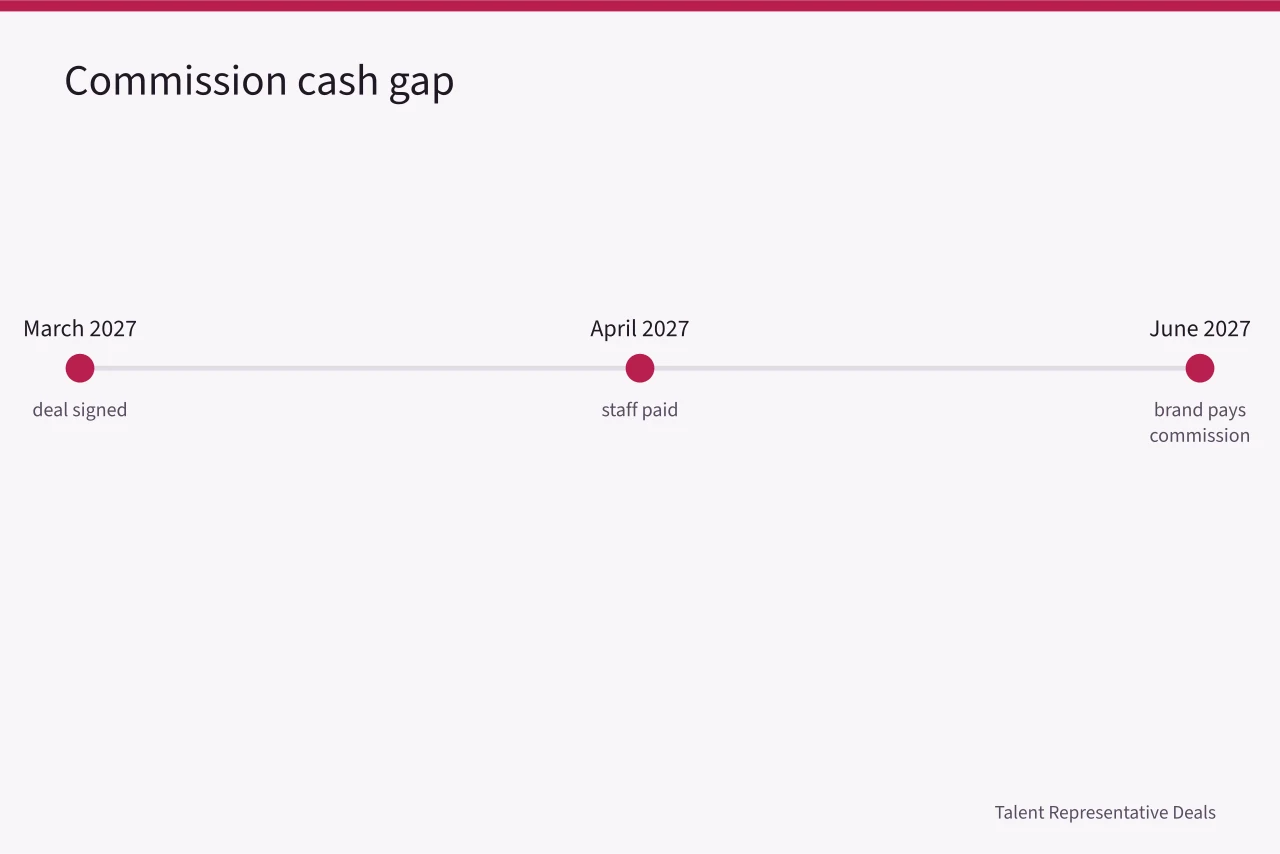
That gap is the whole cash problem. Revenue is real on paper and absent from the bank account.
Commission commonly runs 15% to 20% of a brand deal, and net 30, net 60 and net 90 terms are all standard. On a $10,000 campaign, a 20% commission is $2,000 that may not arrive for three months.
Book income on the payment date. Then the forecast reflects money you can actually spend.
The Monday routine
Thirty minutes, same time each week, same person. The first run of 2027 falls on Monday, January 4. The order matters more than the length.
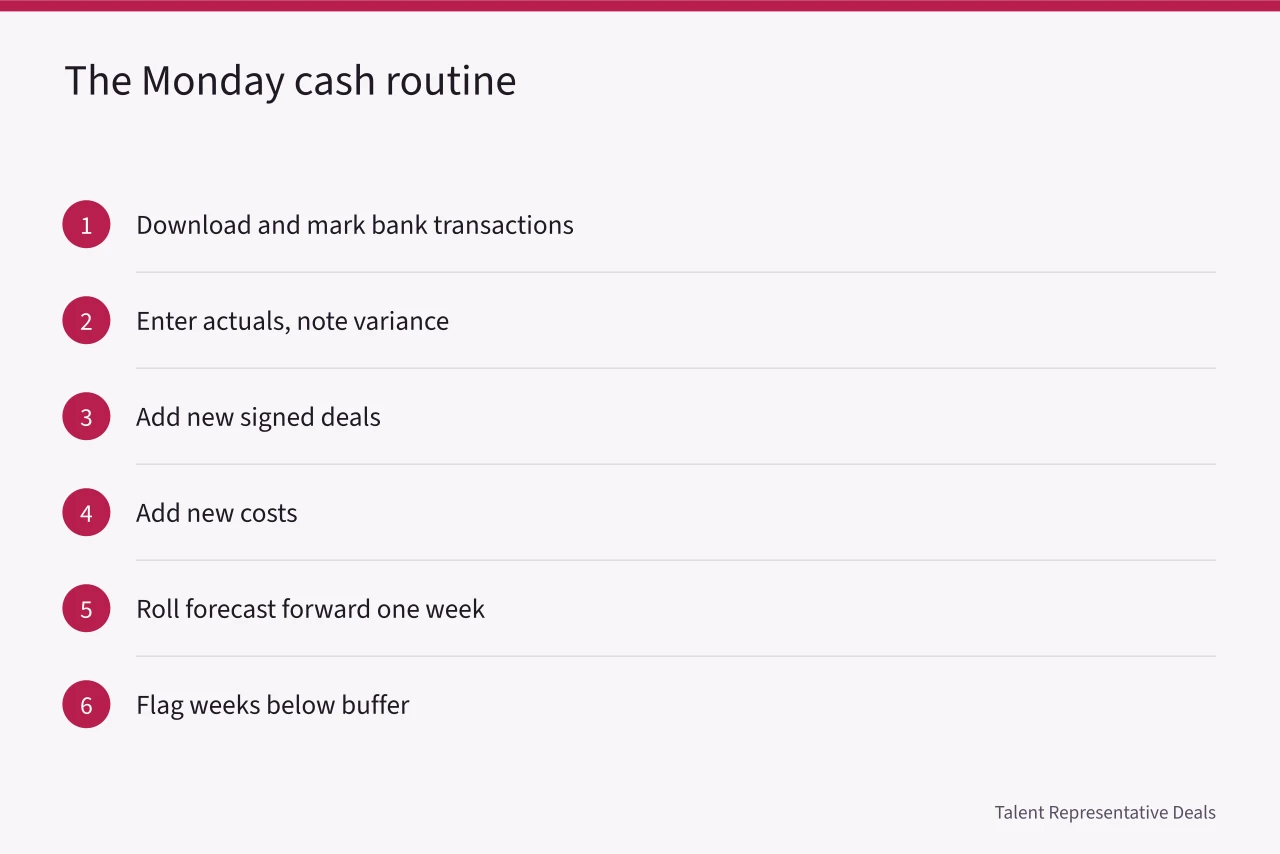
- Download last week's bank transactions and mark each one against the forecast line it belongs to.
- Enter actuals in the past week's column. Do not adjust the forecast to match; note the variance instead.
- Add any new signed deals with their expected payment month, taken from the brand's stated payment terms.
- Add new costs: contractor invoices, software renewals, event deposits.
- Roll the forecast forward one week so it always covers thirteen weeks.
- Flag any week where the closing balance falls below your minimum operating buffer.
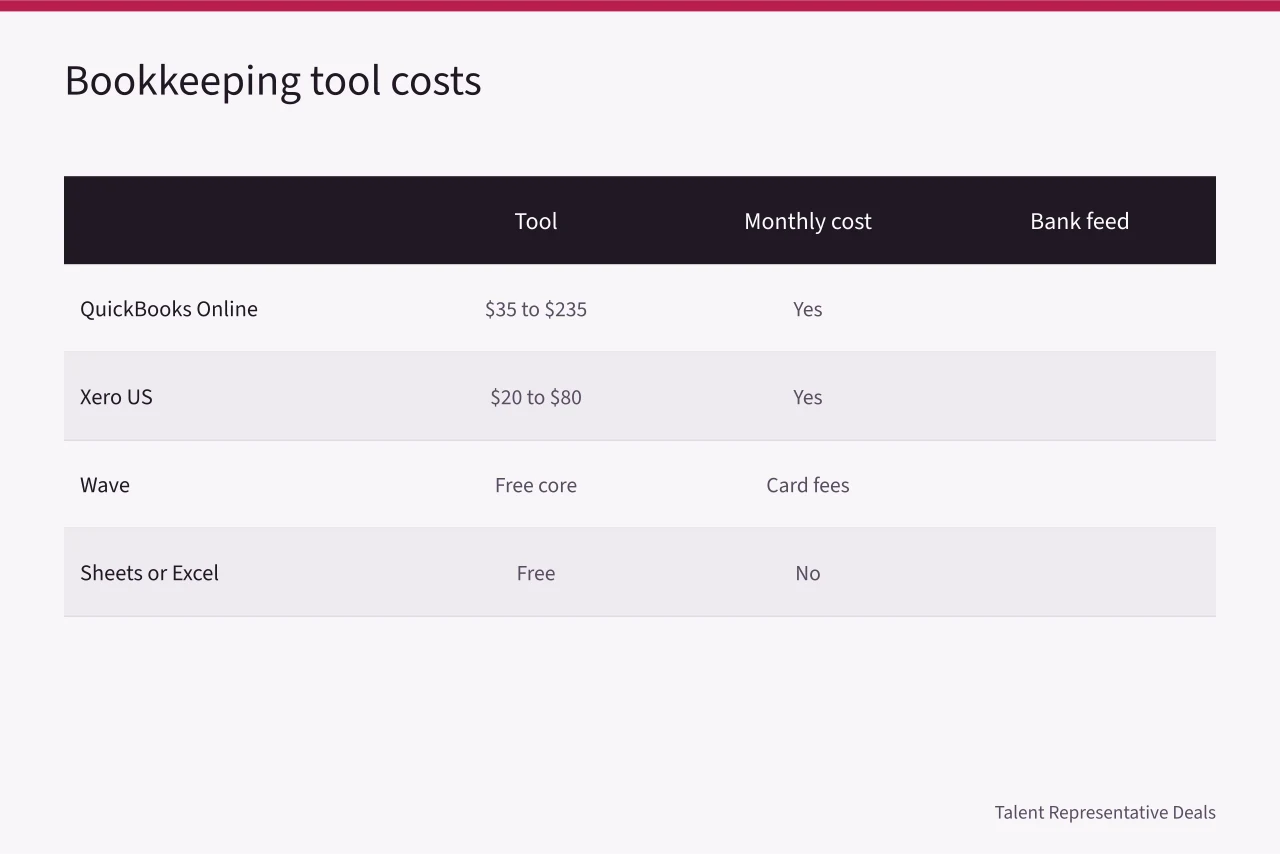
Most of the routine is a bank feed plus a spreadsheet. QuickBooks Online and Xero both import transactions automatically. QuickBooks Online list prices run from roughly $35 a month for Simple Start to about $235 for Advanced, and Xero's US tiers sit near $20 to $80.
Wave keeps core accounting and invoicing free and charges on the card payments it processes. A Google Sheets or Excel template costs nothing, but it has no bank feed.
Float builds the thirteen-week view from a Xero or QuickBooks Online connection. Fathom turns the same data into dashboards. Mercury and Relay offer business checking with no monthly fee, and both feed the bookkeeping apps.
Gusto's Simple payroll plan runs about $40 a month plus roughly $6 per employee.
The buffer is your number, not an industry figure. Set it at one month of fixed costs, then adjust after two quarters of real data.
Dates in 2027 that move cash belong on the same calendar as the weekly columns.
- Thirteen-week window: the first run covers January 4 to March 29, 2027.
- 1099-NEC forms for 2026 contractor payments: due to contractors and the IRS by the end of January 2027.
- Quarter closes: March 31, June 30, September 30 and December 31.
- Quarterly estimated taxes: April 15, June 15 and September 15, 2027, then January 18, 2028 for the fourth quarter.
- Holiday campaign payables: November and December, when overtime and contractor invoices stack.
Cost lines compared
| Cost line | Behavior in an influencer talent management agency | Watch for |
|---|---|---|
| Fixed overhead | Due whether or not a brand deal closes | Software and office renewals stacking in one month |
| Variable deal costs | Rise and fall with signed campaigns | Editing, travel, and shoot costs nobody assigned |
| Wages and owner draw | Flexes less than it looks | Overtime through holiday campaign season |
| Contract templates and legal review | Lumpy: quiet, then a large bill | No reserve for the next revision |
| Talent advances | Leaves before the brand pays | Advances booked against unsigned deals |
| Bookkeeping and forecasting tools | QuickBooks Online or Xero, plus Float or Fathom | Annual price rises and duplicate subscriptions |
| Payroll and banking | Gusto payroll, Mercury or Relay checking with no monthly fee | Processor fees on card spend and same-day transfers |
Who owns which line
Cash tracking fails when everyone assumes someone else is watching. Assign one name per line.
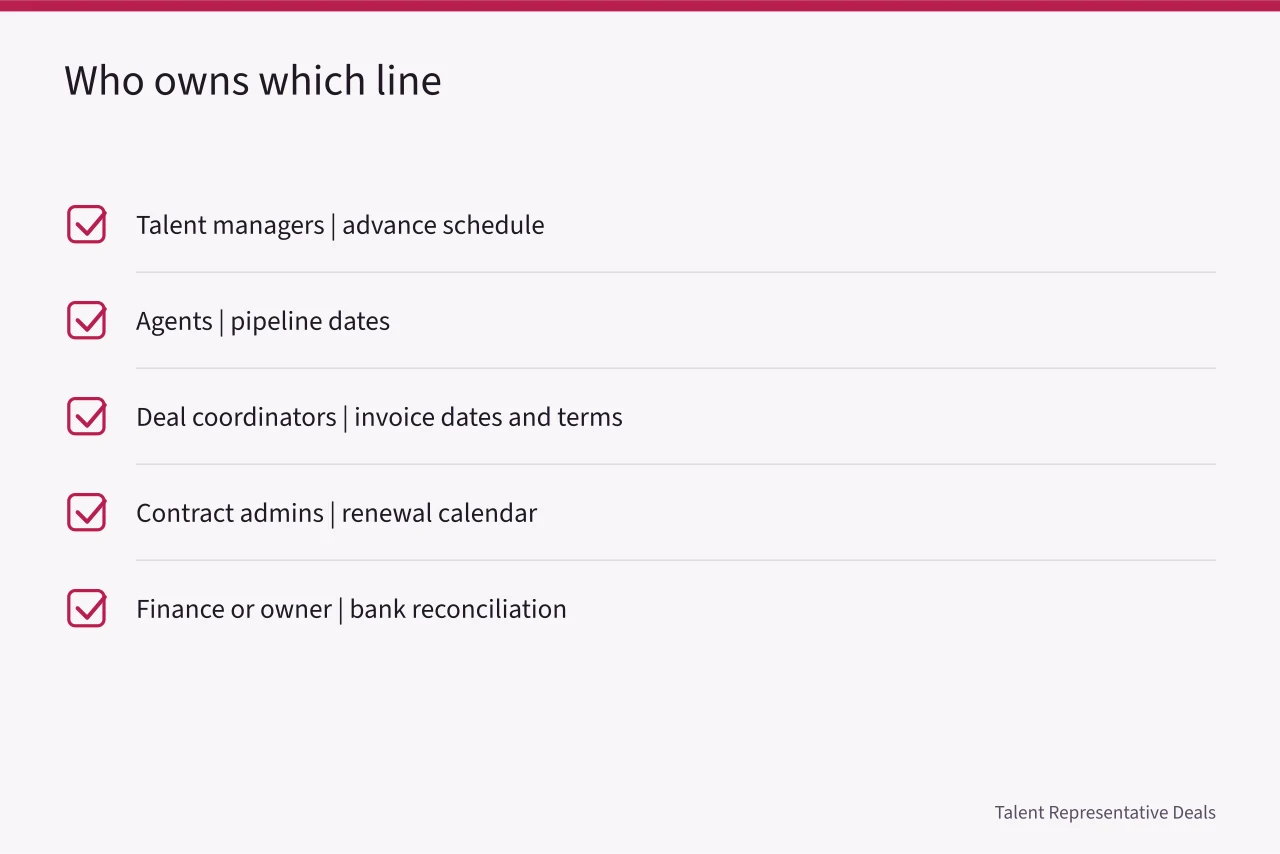
Talent managers own the advance schedule and confirm each advance against a signed deal. Agents and partnership leads own the pipeline dates that feed the forecast. Deal coordinators own invoice dates and payment terms. Contract administrators own the renewal calendar for templates and registrations.
Finance staff or the owner reconcile the bank. That is a different job from forecasting, and it should be a different person where the team allows it.
When the agency adds staff, the handoffs need writing down. A documented employee training checklist keeps the Monday routine intact through turnover.
What the forecast should show
Three numbers per week: opening balance, expected receipts, expected payments. The closing balance decides whether you can hire, advance, or wait.
Label the columns W1 to W13 with the Monday date above each. The first run of 2027 reads January 4 at W1 and March 29 at W13.
Track commission receipts by brand, not in one lump. A single late payer then shows up as a named risk instead of a vague shortfall.
If you want the reporting side built out, the KPI and dashboard structure in this agency software and KPI guide covers which measures belong on a weekly view.
Records and system hygiene
The IRS accepts any recordkeeping system that clearly shows income and expenses, as long as the documents behind purchases, sales, payroll, and assets are retained. See What kind of records should I keep? for the categories it expects.
Supporting documents generally stay three years. Employment tax records stay four years from the due date or the payment date, whichever is later.
Cash records live in the same systems as client data, so access matters. The NIST Small Business Quick-Start Guides give small firms a starting point, and CISA's small business guidance collects current resources.
Two checks before you commit to any bookkeeping or agency platform:
- Export a full year of transactions and confirm the format opens without the vendor.
- Confirm who owns the data and what happens to it if you cancel.
Data limits found after cancellation are the real risk, not the demo.
Common questions
How often should the forecast be rebuilt from scratch?
Twice a year is usually enough. Weekly updates handle the near term, but a fresh build catches stale assumptions about payment timing that have quietly drifted.
What if a brand pays later than the forecast assumed?
Move the receipt to the later week and check whether any payment in between now breaches your buffer. If it does, decide that week, not at month end.
Does commission count as cash when the contract is signed?
No. It counts when the brand pays. Until then it belongs in the pipeline, not the balance.
What do the tools cost?
Bookkeeping typically runs $20 to $100 a month for a small agency. Forecast add-ons like Float or Fathom usually cost $30 to $80 a month. Mercury and Relay checking is free, and Gusto payroll is priced per person on top.