Guides
What is changing in talent management agency demand in 2027
Brand deals are moving to long-term ambassador contracts, and talent agencies that price per post are losing ground to those selling retainers.
What to take away
- Brand budgets keep moving from one-off sponsored posts to multi-quarter ambassador deals. UTA, CAA and WME have built brand-partnership teams around those retainers.
- Deals routinely name the creator, platform, usage window and exclusivity category. TikTok Creator Marketplace, Meta Creator Marketplace and YouTube BrandConnect now carry those terms into the deal flow.
- Retainer and percentage splits are replacing flat per-post fees. That moves agency revenue onto a monthly billing cycle.
- Disclosure language is a contract term now, not a caption afterthought. The FTC holds both the brand and the creator to it.
- Compliance work in California and New York is a registration and bonding question, not a marketing one.
This article provides general creator-management agency information, not individualized licensing, fiduciary, endorsement, advertising, copyright, publicity-rights, union, employment, tax, contract, or legal advice.
Duties depend on these factors:
- jurisdiction
- representation authority
- creator
- platform
- sponsor
- content
- rights
- term
- compensation
Confirm registration and bonding questions with the California Labor Commissioner or your state licensing authority, and contract questions with a licensed attorney.
2027 demand drivers: ambassador retainers, usage rights, exclusivity
Three shifts are reshaping what brands ask an agency to sell.
Ambassador contracts over one-off posts. A brand that used to buy six separate posts now writes one nine-month agreement with a monthly deliverable count. That single change moves the agency from project billing to retainer billing, and it moves the creator from a fee per post to a fee per month.
Nike, L'Oréal and Amazon now run creator ambassador programs with quarterly deliverable counts. UTA bought Digital Brand Architects in 2022 to serve those retainers. CAA Brand Management and WME's brand partnership group sell similar programs.
Usage rights priced separately. Brands increasingly want paid-media rights, whitelisting, and a defined territory. Each of those is a line item, and each one has a start and end date. An agency that bundles them into the base fee is underpricing the deal.
Meta Creator Marketplace and TikTok Creator Marketplace let brands license creator content for paid media. YouTube BrandConnect includes whitelisting. Agencies typically price whitelisting at 10% to 20% of media spend. A 12-month usage window costs more than a 30-day window.
Category exclusivity as the expensive clause. A creator who cannot work with a competing brand for six months is giving up real income. That clause should carry its own number, not sit in the boilerplate.
Sephora and Ulta compete for beauty creators; Nike and Adidas compete for sport creators. A six-month category exclusivity clause typically adds 20% to 50% to a deal's value.
What a 2027 deal review looks like
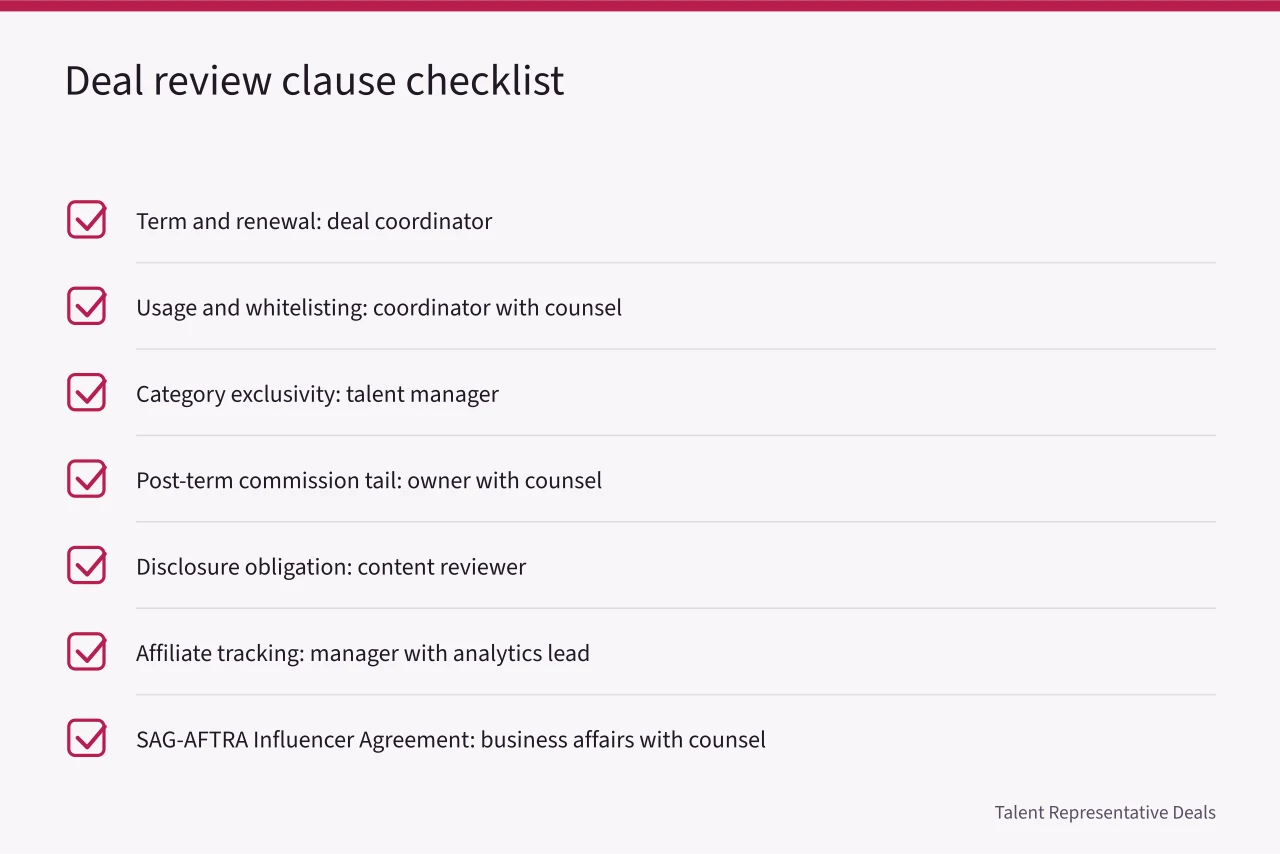
The deal coordinator's checklist has grown. Term, territory, usage window, and exclusivity category all need a named owner before signature. Morality clause and post-term commission tail also need a named owner.
| Clause | What it controls | Who reviews it |
|---|---|---|
| Term and renewal | How long the brand holds the creator | Deal coordinator |
| Usage and whitelisting | Where and how long the brand runs the content | Deal coordinator with counsel |
| Category exclusivity | Which competing brands the creator cannot take | Talent manager |
| Post-term commission tail | What the agency earns after the contract ends | Owner with counsel |
| Disclosure obligation | Who writes and approves the FTC disclosure | Content reviewer |
| Platform usage license (TikTok Creator Marketplace, Meta Creator Marketplace, YouTube BrandConnect) | Where and how long the brand runs paid media | Deal coordinator with counsel |
| Affiliate tracking (LTK, Amazon Influencer Program, Shopify Collabs) | Commission on sales and attribution window | Talent manager with analytics lead |
| SAG-AFTRA Influencer Agreement | Union minimums, pension and health, disclosure | Business affairs with counsel |
The FTC's guidance on endorsements, influencers, and reviews applies to both the brand and the creator. Put the disclosure language in the contract, not in a caption written the morning of the shoot. The FTC updated its Endorsement Guides in 2023 and sent warning letters to brands and creators that year.
Grin, CreatorIQ, Traackr and Aspire sell campaign tracking that brands use to measure retainer deliverables. Those tools report on post volume, usage windows and affiliate sales.
Pricing the work
Most agencies price one of three ways: a flat monthly retainer, a percentage of gross deal value, or a hybrid with a retainer credited against commission. The right split depends on deal volume, not on what a competitor charges.
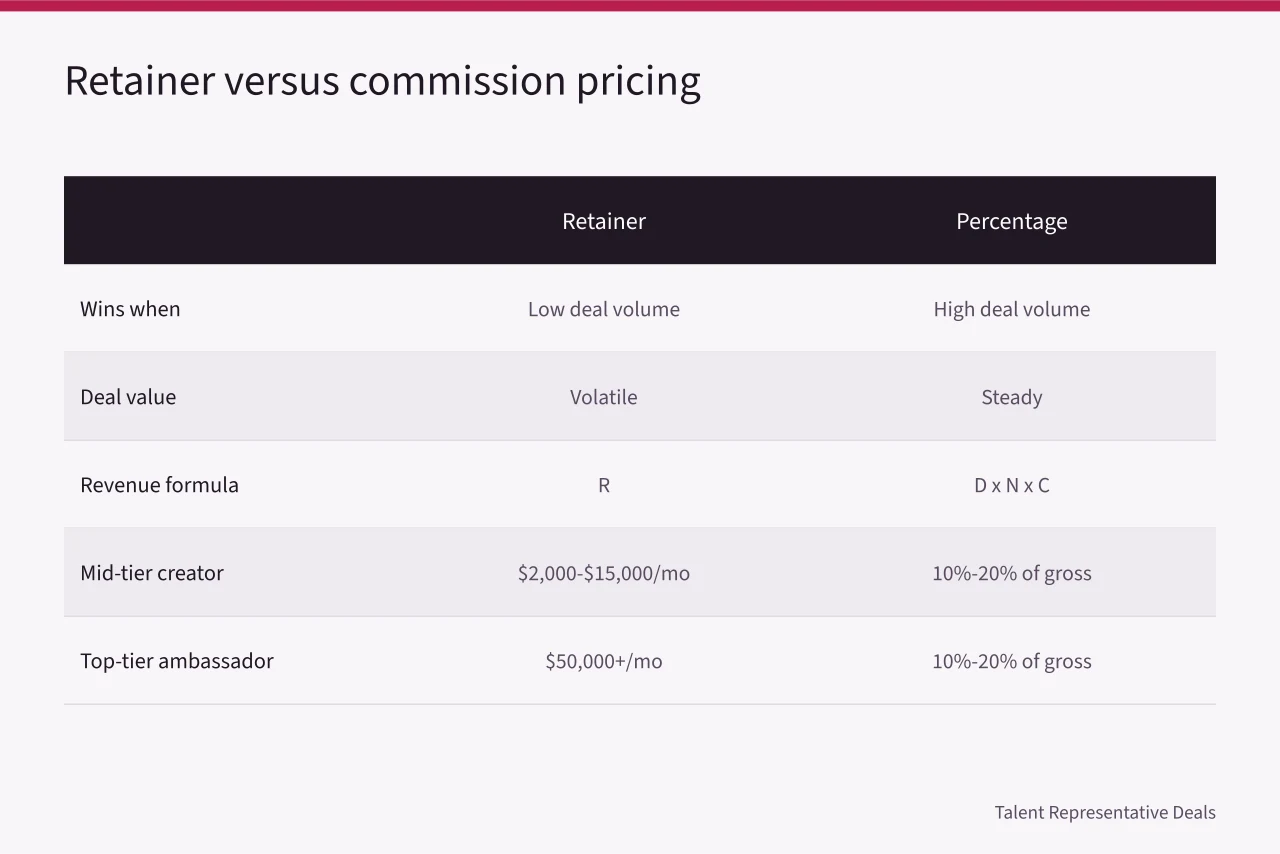
Run the arithmetic in your own numbers. If monthly retainer is R, average deal value is D, deals per month is N, and commission rate is C, then retainer revenue is R and commission revenue is D x N x C.
The retainer wins when N is low and D is volatile.
The percentage wins when N is high and D is steady.
Talent managers typically take 10% to 20% of gross deal value. A flat retainer for a mid-tier creator typically runs $2,000 to $15,000 per month, depending on deliverable count and exclusivity. A top-tier ambassador deal can carry a retainer of $50,000 or more per month.
Affiliate programs pay commissions by category. LTK and Amazon Influencer Program rates typically run 1% to 20%; Shopify Collabs lets merchants set their own rates.
For benchmarking talent manager costs in your metro, see the BLS Occupational Employment and Wage Statistics tables. These tables publish wage estimates by occupation, industry, state, and metropolitan area. Use them as one input, not as a rate card.
Staffing and cost pressure
Smaller rosters with higher-value deals need fewer coordinators and more senior managers. That reverses the hiring pattern of the last several years, when agencies added junior staff to handle volume.
UTA, CAA and WME have added senior brand-partnership roles. Whalar and Digital Brand Architects staff campaign managers for ambassador programs. Smaller shops are hiring fewer junior coordinators.
Pay rates and labor costs in talent management move with that mix. A shop running ten ambassador contracts a quarter needs a different bench than one running sixty single-post deals, even at the same revenue.
The SBA business guide groups ownership decisions into planning, launch, management, and growth stages. Hiring and finance sit in the later stages, which is where most agencies feel this shift first.
Compliance is not a marketing question
California regulates talent agencies under the Talent Agency Act, which requires a license and a bond filed with the Labor Commissioner. New York and several other states have registration or licensing schemes. Whether a manager needs a license depends on whether the work crosses into procurement of employment, which is a legal question, not an operational one.
SAG-AFTRA's Influencer Agreement covers union-covered branded content and sets minimum rates, pension and health contributions, and disclosure terms. That agreement can change the math on a retainer.
Expanding into a new market before resolving registration in the current one is the failure case most agencies hit. Fix the home-state filing first.
Common questions
Why are retainers replacing per-post fees?
Brands want predictable output across a quarter, and a retainer gives them that. It also gives the agency predictable revenue, which matters more when deal volume is uneven. The tradeoff is that the agency carries the risk if the brand cuts the budget mid-term. Nike and Amazon ambassador programs often run on quarterly deliverable counts.
Does the FTC disclosure rule fall on the agency?
The FTC holds the advertiser and the endorser responsible for clear disclosure of material connections. An agency that negotiates the deal is usually closest to both. Put the disclosure language in the contract and have a named reviewer approve it before the content runs. The FTC's 2023 Endorsement Guides and warning letters apply to TikTok, Instagram and YouTube posts.
What changes for a small agency with five creators?
Less than you would expect on the deal side, more on the compliance side. Five creators in three states can mean three registration questions. Confirm each one with the relevant state authority or a licensed attorney before signing the next contract. California and New York are the two states most agencies hit first.