Guides
Quebec language law for influencer contracts: what agencies must translate
Quebec language law for influencer contracts requires a French version before signing. Agencies that skip translation risk voidable clauses and OQLF fines.
What to take away
- Quebec language law for influencer contracts requires a French version before a creator signs an English-only deal.
- Bill 96 tightened section 55 of the Charter of the French Language for standard form and adhesion contracts.
- Skipping the French version can make commission, usage and renewal clauses unenforceable against a Quebec creator.
- Proof of a French-first offer, not a later translation, is what keeps an agency out of trouble.
Most Canadian talent agencies run deals in English by default. A Toronto agency sends a management agreement, a rate sheet and a renewal side letter, all in English, to a Montreal creator with 90,000 followers. The creator signs. The campaign launches. Nothing breaks for five months.
The costly mistake: a single English contract
The Charter of the French Language treats many influencer management agreements and brand deal side letters as contracts of adhesion because the creator cannot negotiate the printed terms. Bill 96 changed section 55 so that a French version must be given to the adhering party before they can be bound by another language. Sending only an English PDF is the most common costly mistake.
A Quebec creator can later argue key revenue clauses were never validly accepted. The Office québécois de la langue française can investigate after a complaint. For a corporation, a first offence can lead to a fine of up to $30,000 CAD, and repeat offences can go higher. Prevent this by sending the French version first, obtaining a written confirmation of receipt, and then offering the English version as a convenience.
Agencies that also handle US talent face a parallel trap; Cross-border representation explains how a US agency signs Canadian creators.
Mistakes that look fine at first
Many agencies translate the main agreement and stop there. They leave the rate card, exclusivity schedule, usage rights annex and renewal side letter in English. Those documents look like attachments, not contracts, so the agency assumes they are outside section 55. That assumption fails.
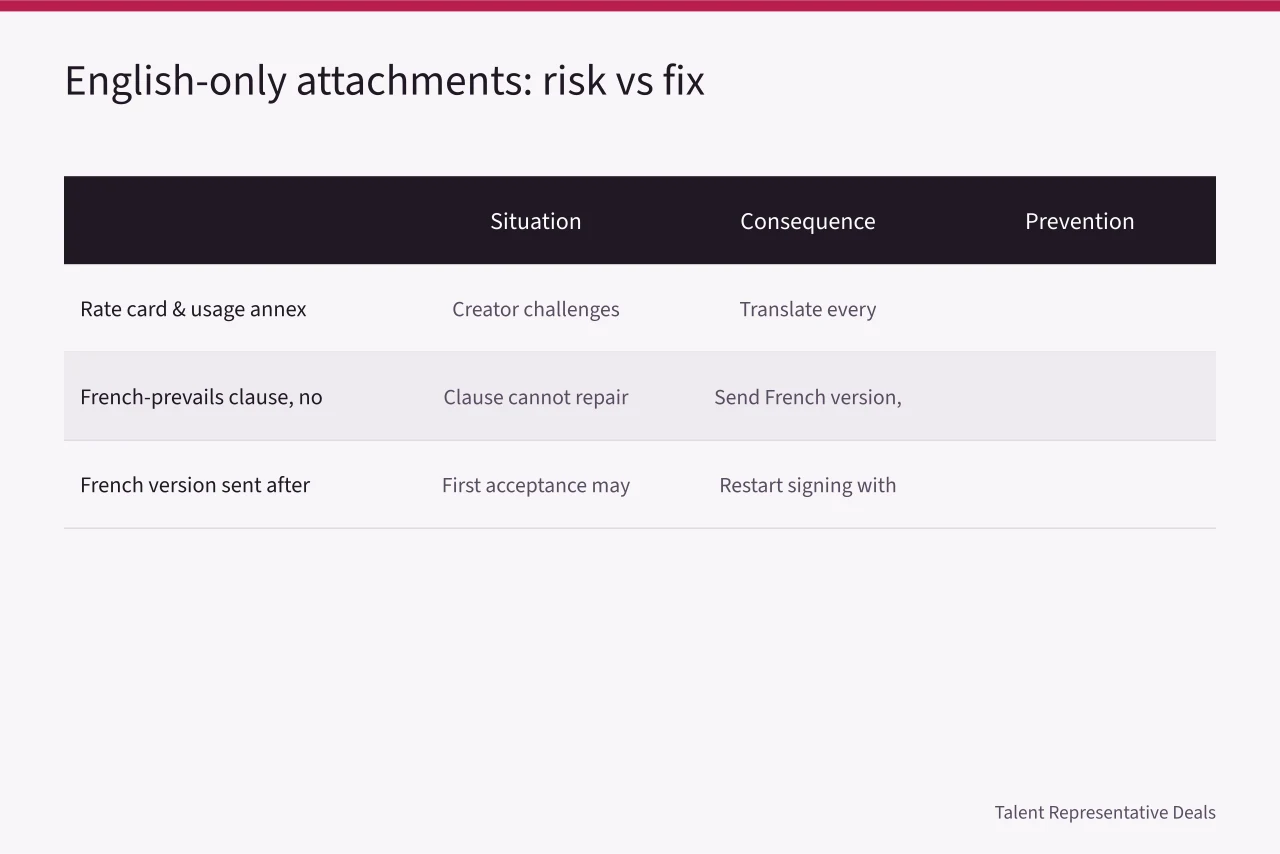
| Situation | Consequence | Prevention |
|---|---|---|
| Main agreement is French, but rate card and usage annex stay English-only | Creator can challenge commission and usage terms months later | Translate every schedule, exhibit and side letter before signature |
| Agency adds a clause saying French version prevails but never supplies it | The clause cannot repair a missing French document | Send the French version and keep a dated delivery record |
| Agency sends a French version after the creator signed English-only | The first acceptance may be invalid | Restart the signing with the French version first |
Quebec language law for influencer contracts attaches to the whole document package, not only the cover pages. A bilingual clause does not help if the French version did not arrive before the creator's signature.
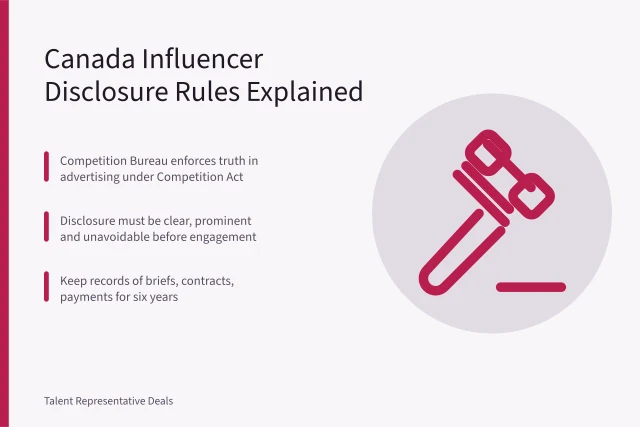
Quebec language rules sit beside the federal Canadian influencer marketing disclosure rules, so a fully compliant deal needs both.
Mistakes that only show up later
Renewals and amendments often stay hidden for months. A one-year management agreement signed in French auto-renews. The agency sends the renewal notice and a new commission rate in English only. The creator keeps posting. Six months later the creator leaves for another agency and disputes the higher commission. The missing French renewal notice surfaces only then.
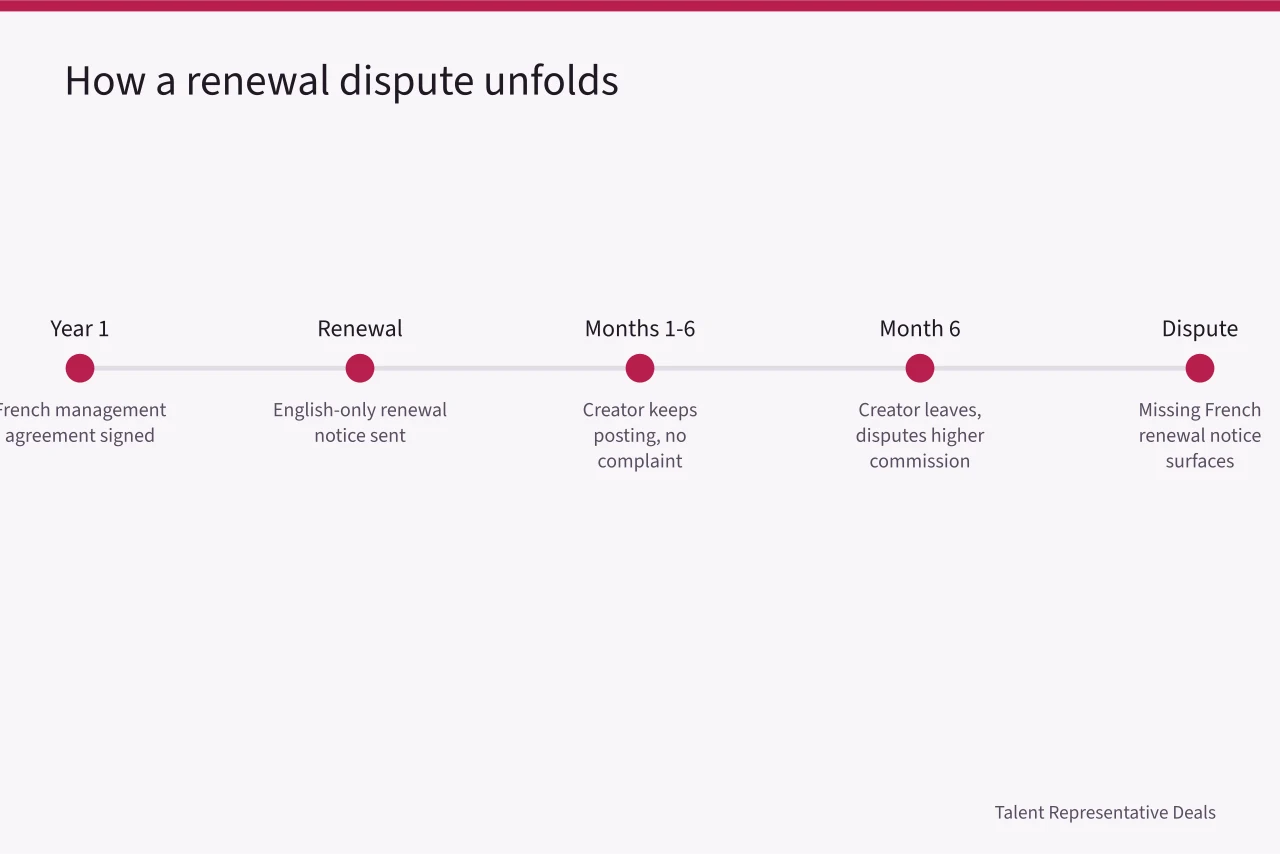
From the agency's view, the deal was clean because the original contract was French. From the law's view, the renewal notice is a fresh adhesion contract that also needed a French version. This mistake can stay invisible for a full campaign cycle or longer, because nobody checks the renewal language until a payment dispute.
Prevention is simple. Treat every renewal, amendment, termination notice and rate change as a new adhesion contract. Send the French version first and keep the dated record.
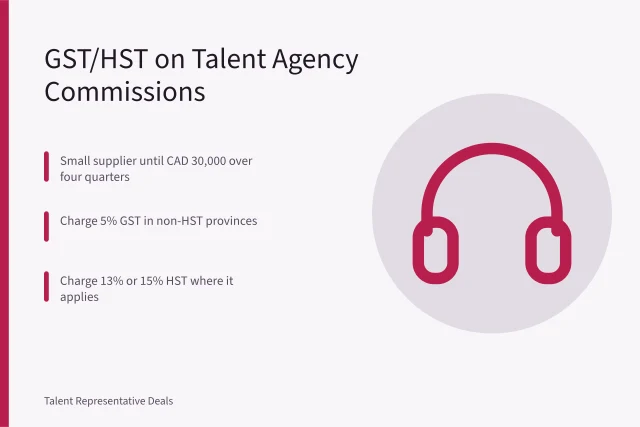
When a renewal changes commission, agencies must also recheck GST/HST on talent agency commissions for Quebec clients, because the tax treatment follows the revised fee.
Example: a Montreal creator and a Toronto agency
Scenario: a Toronto agency signs a Montreal creator for a skincare campaign. The agency emails an English-only talent agreement with a two-year auto-renewal. The creator signs on the same day. Three months into the campaign, the creator asks for a French version after reading about Bill 96. The agency translates the document retroactively and sends it. Eight months later, the creator terminates and refuses to pay the final commission because the original acceptance was not French-first.
The agency's defence is the signed English PDF and the later translation. It fails because the later translation did not precede the signature. The French version arriving months later does not cure the original acceptance.
The Office québécois de la langue française can issue a formal notice and, for repeated corporate failures, a penalty that reaches $30,000 CAD. The commission clause itself can be set aside by a Quebec court.
What they have in common
Each failure has the same root: the agency equates a signed English document with consent. Quebec law reverses that for adhesion contracts. The creator must receive the French version first; only then can a choice of English be valid. Without a dated delivery record, the agency's position is weak.
The common thread is proof. The agency can show English files, but it cannot show that the French version arrived before signature.
Agencies that already follow the federal Competition Bureau's disclosure expectations for influencer campaigns often assume the same provincial oversight does not apply. It does. Quebec's language regulator has a separate mandate, and a single English-only contract can trigger it.
The French version cannot repair a missing core term, so agencies should start from a contract that includes the terms agencies should never leave out.
Common questions
Does Bill 96 require every talent agency contract with a Quebec creator to be in French? Not every contract. Standard form and adhesion contracts covered by section 55 must be available in French first. A negotiated bespoke deal is less likely to be covered, but most influencer agreements are adhesion contracts.
Can a Quebec creator sign an English-only contract if both sides agree? Only if the agency provided a French version first and the creator then expressly chose to be bound by English. The choice must come after receiving the French document.
What is the penalty for skipping the French version? The Office québécois de la langue française can order compliance and impose fines. For corporations, a first offence can reach $30,000 CAD, and repeat offences can be higher.
Does a later translation fix the original English-only contract? No. A French version sent after signature does not cure the original acceptance. The safest path is to restart the signature with the French version first.