Guides
7 talent agency trust account requirements your state enforces
Talent agency trust account requirements vary by state, with California and New York enforcing the strictest rules on client funds and disclosures.
What to take away
- A talent agency that holds money belonging to a client is acting as a fiduciary, and most states that license agencies require those funds to sit in a separate trust or escrow account.
- California and New York are the two states with the most detailed rules, and both treat commingling as grounds for discipline.
- A compliant disclosure names the account, the bank, the signer, the client whose money it is, and the fee deducted.
- Records usually must be kept for a set period, often three to seven years, and must be open to inspection.
- Penalties range from license suspension to personal liability for the shortfall, not just a fine on the business.
Who has jurisdiction
A talent agency holds money that belongs to somebody else. The moment a brand pays a flat fee for a creator, part of that cash is the creator's and part is the agency's commission. State law decides how those two piles must be kept apart.
There is no federal trust account statute for talent agencies. Oversight sits with state regulators: the California Labor Commissioner's Division of Labor Standards Enforcement, the New York State Department of Labor, and licensing boards in states such as Texas and Florida. The SBA guide on licenses and permits points agency owners to those state filings, which is why registration and trust rules usually arrive together.
Agencies that only manage staff and never touch client money face fewer of these rules. Agencies that collect brand payments on behalf of creators face all of them.
What must be disclosed
A trust account disclosure is not a marketing document. It is a record that ties a specific deposit to a specific client and a specific deal.
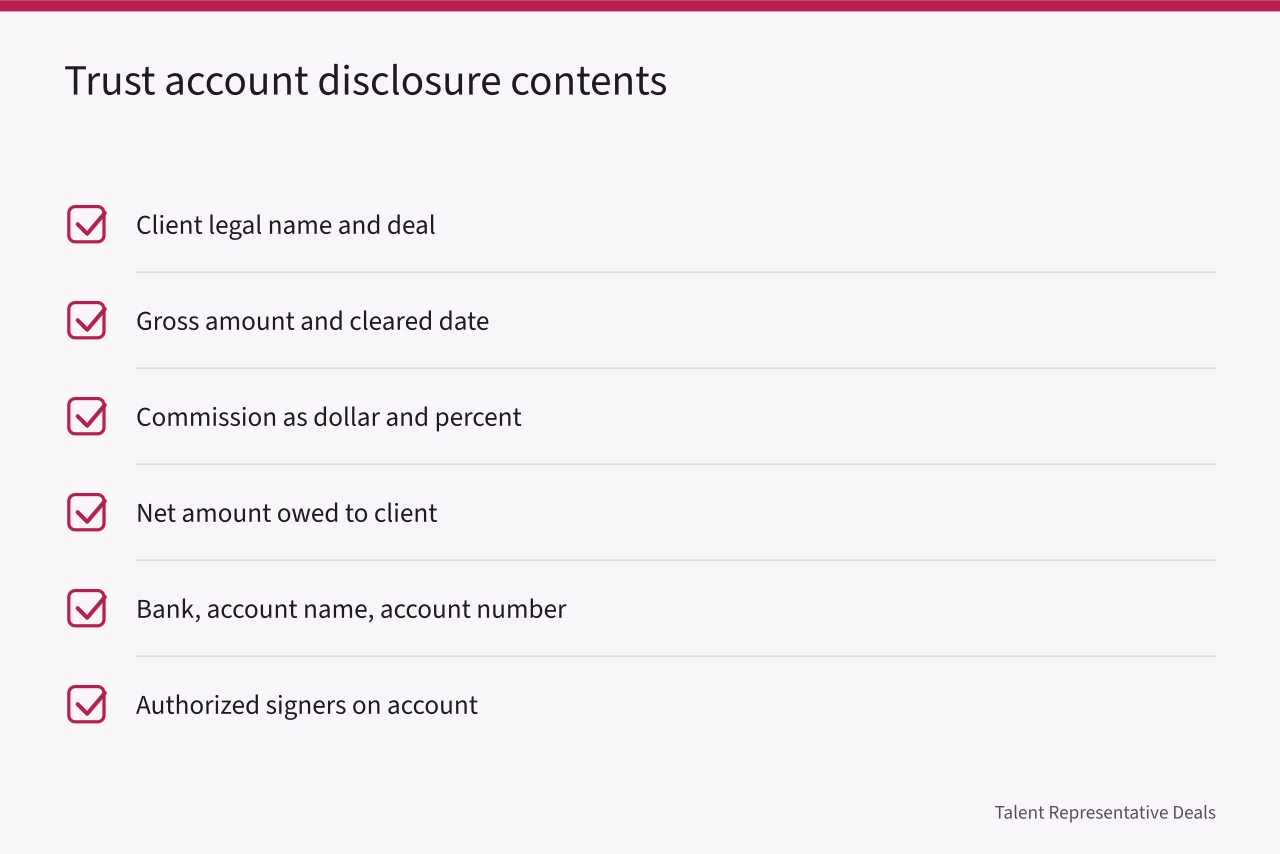
A compliant disclosure contains:
- The client's legal name and the deal it relates to
- The gross amount received and the date it cleared
- The commission or fee deducted, shown as a dollar figure and a percentage
- The net amount owed to the client
- The bank, account name and account number holding the funds
- The name of every person authorized to sign on that account
California adds a timing element. Funds must be deposited and the client must be able to see the accounting within a defined window, not at the end of the year. New York treats the account as held in trust for the client's benefit, which means the agency cannot use the balance for operating costs even briefly. The Cornell Wex entry on commission explains why the commission portion is the agency's own money only after it is earned, not when it is received.
Records to keep
Bookkeeping for a trust account is separate from bookkeeping for the business. The agency's own profit and loss statement does not satisfy the requirement.
Records typically include bank statements for the trust account, a client ledger showing every deposit and withdrawal, signed deal memos, and the disclosure sent to each client. Retention periods vary. Three years is common; seven years appears in several states and matches the period the IRS expects for employment tax records under Publication 15.
Agencies that also pay creators as workers rather than contractors carry a second set of obligations. The distinction between the two arrangements is set out in the IRS guidance on worker classification, and it changes which account the money moves through.
What happens if you do not
The concrete consequence is personal exposure. When a regulator finds that client funds were mixed with operating funds, the usual remedy is not a warning letter. California can suspend or revoke an agency's license and order restitution. New York can pursue the individual signer.
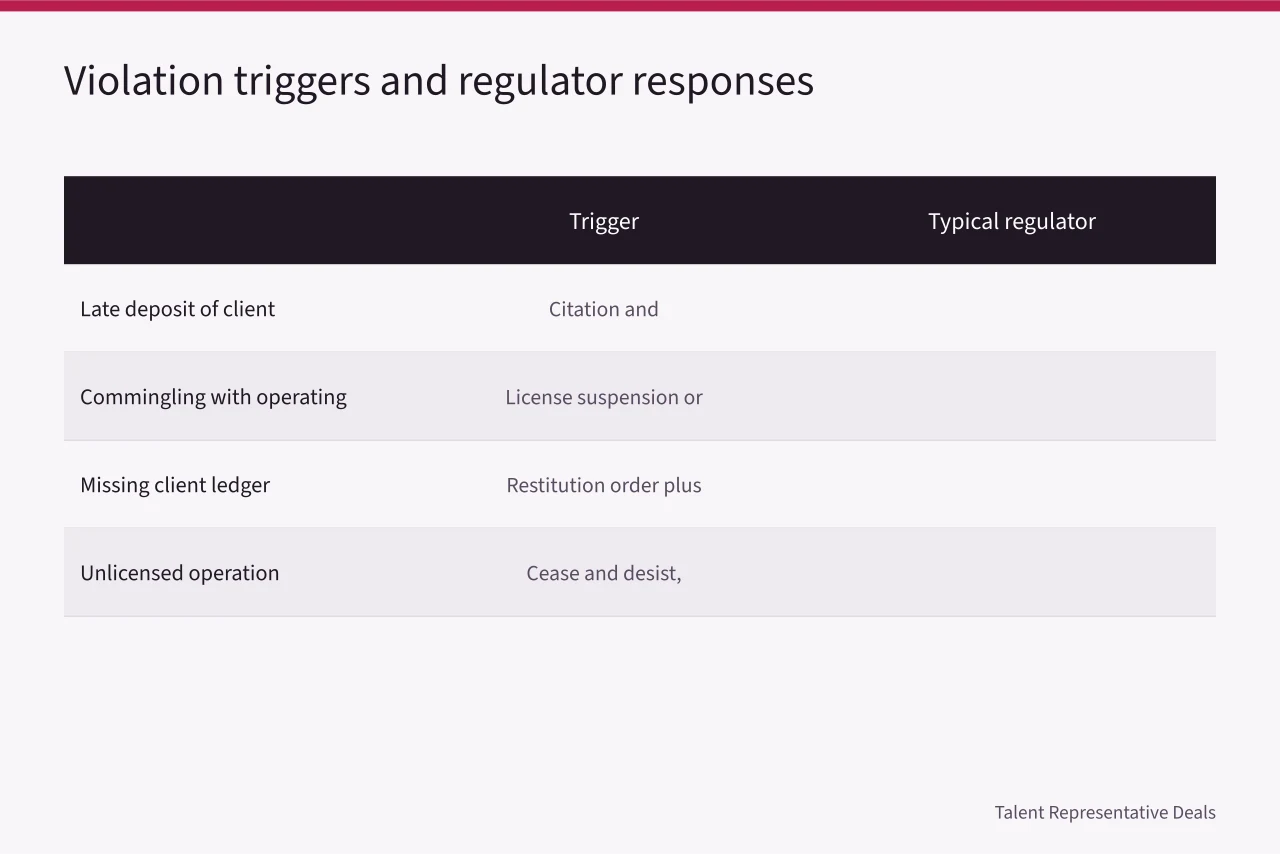
| Trigger | Typical regulator response |
|---|---|
| Late deposit of client funds | Citation and corrective filing |
| Commingling with operating account | License suspension or revocation |
| Missing client ledger | Restitution order plus audit |
| Unlicensed operation | Cease and desist, possible fines |
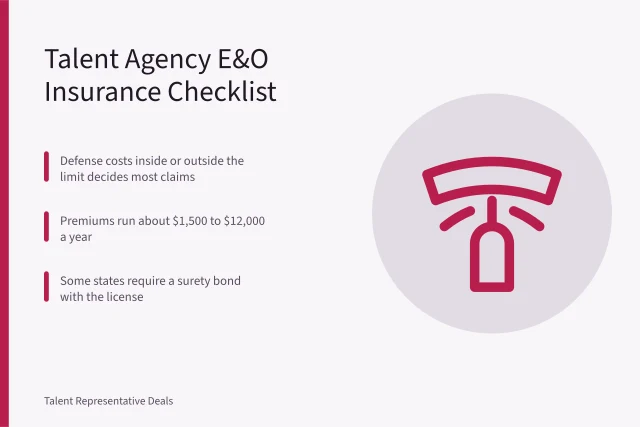
A shortfall discovered during an audit is treated as a debt the signer owes, which is why errors and omissions coverage matters. The overview of errors and omissions insurance describes defense costs and professional liability, the two pieces that apply when a client sues over missing money.
Where the rules differ by place
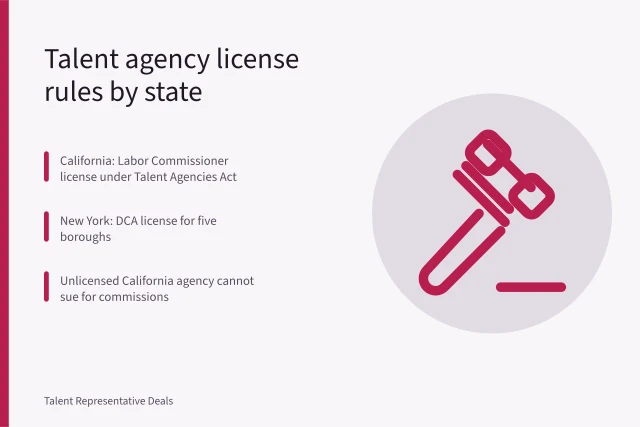
California licenses talent agencies through the Labor Commissioner and requires a bond and a trust account as conditions of the license. The California talent agency registration and contract rules walk through the filing sequence, which is worth reading before a first big payment clears.
New York regulates employment agencies under state labor law and applies trust principles to client funds. Texas and Florida rely more on general business registration, so an agency operating there may face fewer specific trust rules but the same fiduciary duty under common law. A side-by-side view of those two states sits in the comparison of Texas and Florida registration.
Agencies that sign creators outside the US inherit another layer. When a US agency signs Canadian creators, withholding and reporting questions appear that a domestic trust account does not answer, covered in the guide to cross-border representation for Canadian creators.
Building the calendar of filings around all of this is easier than reacting to an audit. The US talent agency compliance calendar maps FTC deadlines against state filings so nothing slips.
Common questions
Does every state require a trust account for talent agencies? No. States that license talent or employment agencies usually do, and California and New York are the clearest examples. States without a licensing scheme still apply fiduciary duties through general law, so separating client money remains the safe practice.
Can an agency use client funds to cover a short-term cash gap? Not legally. Even a transfer repaid within days is commingling, and an audit that catches the transfer does not care that the balance was restored.
How long must trust account records be kept? Three to seven years depending on the state and the type of record. Employment tax records tied to creator payments should follow the IRS period in Publication 15.
What is the first sign an audit is coming? A request for the client ledger and bank statements covering a specific period. An agency that cannot produce both quickly is already behind.