Guides
Talent agency license requirements by state: what to file before signing
Talent agency license requirements by state vary widely, from California Labor Commissioner registration to New York DCA. Here is what to file before signing.
What to take away
- There is no federal talent agency license. Authority sits with states and, in some places, counties and cities.
- California requires a talent agency license from the Labor Commissioner before you can procure employment for artists.
- New York requires a talent agency license from the NYC Department of Consumer and Worker Protection if you operate in the five boroughs.
- Most states have no talent-specific license, but general business registration, a registered agent and a surety bond often apply.
- Signing a client before the license is issued can void the contract and trigger refunds.
Who has jurisdiction
A talent agency license is a state instrument. No federal agency issues one. The United States has no national registry equivalent to a single licensing body, so the filing depends on where you sit and where you procure work.
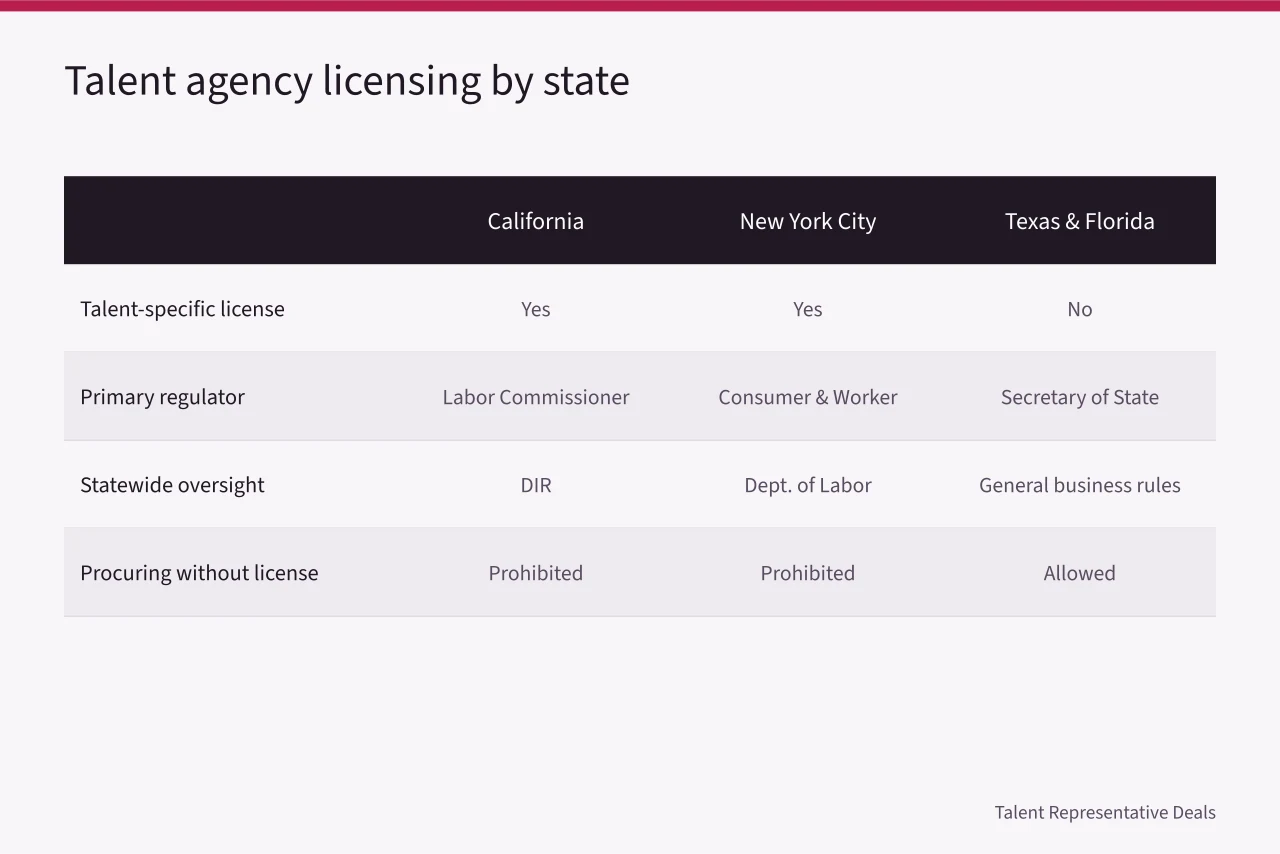
California is the strictest. The Labor Commissioner, inside the Department of Industrial Relations, licenses talent agencies under the Talent Agencies Act. You cannot procure employment for an artist without a license. Procuring means finding, negotiating or arranging engagements.
New York is the second anchor. The Department of Consumer and Worker Protection licenses employment agencies, and talent agencies fall under that umbrella when they operate in New York City. Statewide, the Department of Labor oversees placement activity.
Other states treat talent representation as ordinary business activity. Texas and Florida, for example, do not issue a talent-specific license. You register an entity, get an Employer Identification Number and comply with general commercial rules. For more on those two states, see Texas and Florida business registration.
A license issued in one state does not travel. Procuring work for a client in a state where you are unlicensed is the exposure, not where your office sits.
What must be disclosed
A compliant filing is more than a form. Regulators want to know who owns the agency, who runs it, and how money moves through it.
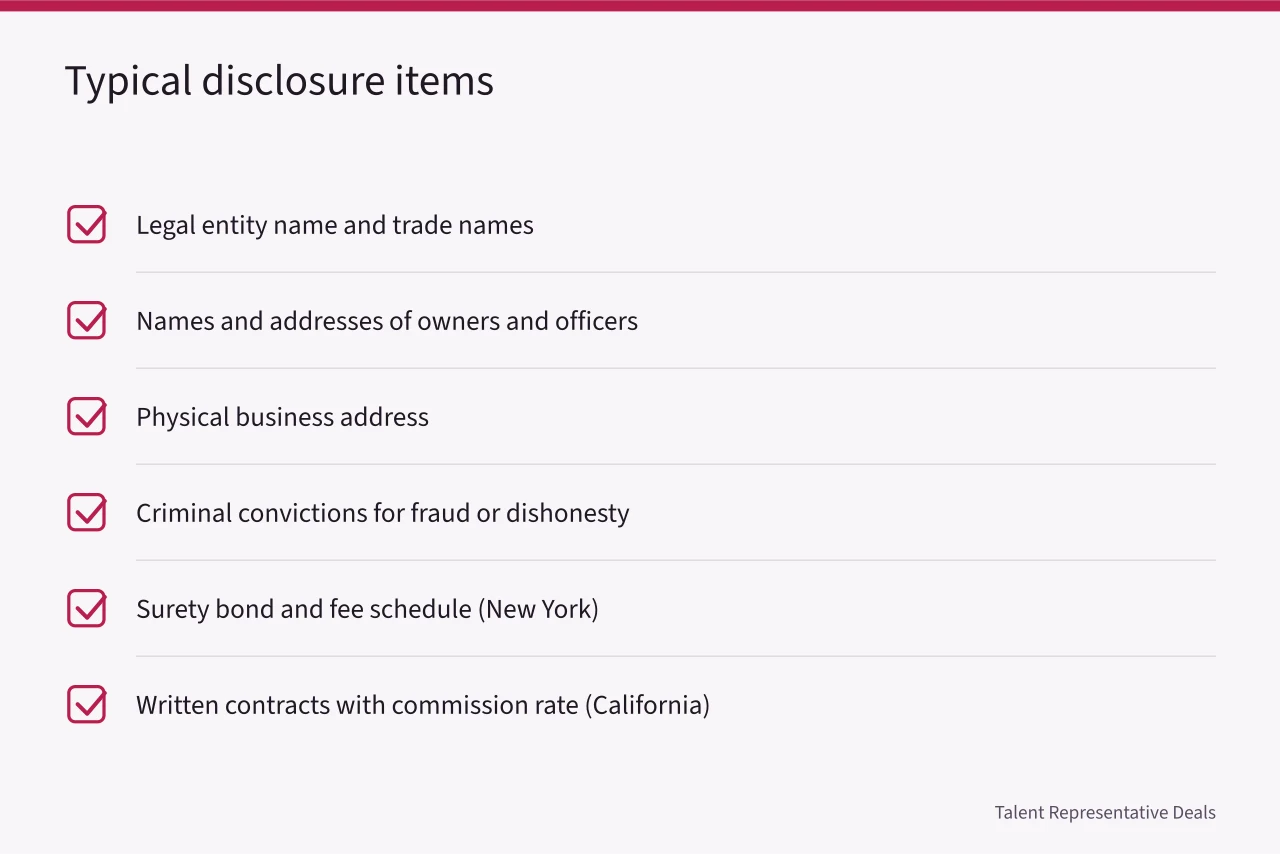
Typical disclosure items include the legal entity name and any trade names, the names and addresses of owners and officers, and the physical business address. You also disclose whether any owner has been convicted of a crime involving fraud or dishonesty.
California adds contract requirements. Agency contracts must be in writing, must state the commission rate, and must not exceed the statutory maximum term. The client gets a copy. Fee disputes go to the Labor Commissioner, not to court first.
New York requires a surety bond and a schedule of fees filed with the city. The bond protects clients if the agency mishandles funds. Fees must be posted where clients can see them.
Both states expect segregated trust handling for client money. Commissions and pass-through payments do not belong in the operating account. The general principle behind trust accounts is that client funds stay separate until earned.
Records to keep
Licensing regimes are record-keeping regimes. The file you keep is the file you defend.
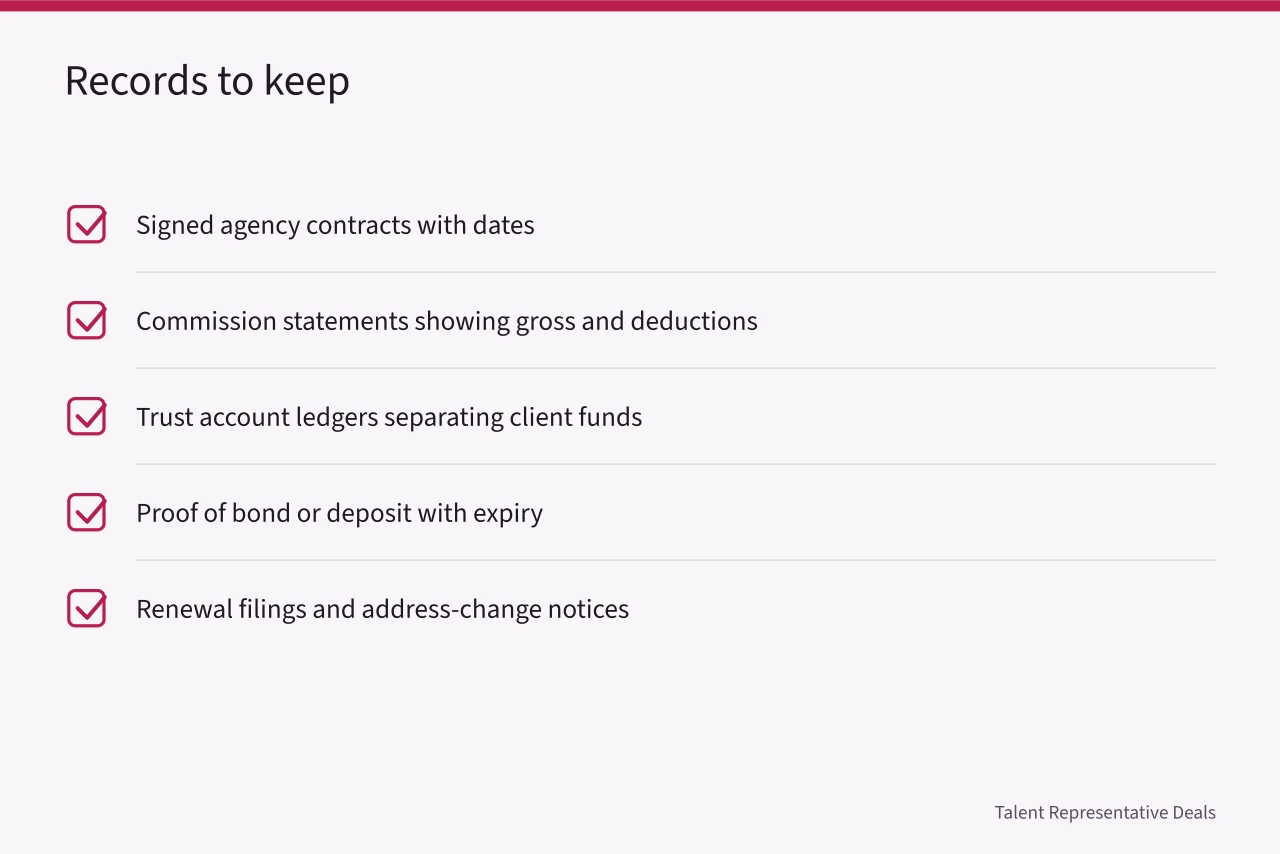
- Signed agency contracts for every represented client, with dates
- Commission statements showing gross deal value and the amount deducted
- Trust account ledgers separating client funds from operating money
- Proof of bond or deposit, with the current expiry date
- Renewal filings and any change-of-address notices
The IRS expects clean records too, because commission reporting and worker classification both depend on them. Whether a creator is an independent contractor or an employee changes what you file.
What happens if you do not
In California, an unlicensed agency cannot sue to collect commissions. That is the concrete consequence. A court will not enforce the contract, and the artist can petition the Labor Commissioner for return of money already paid.
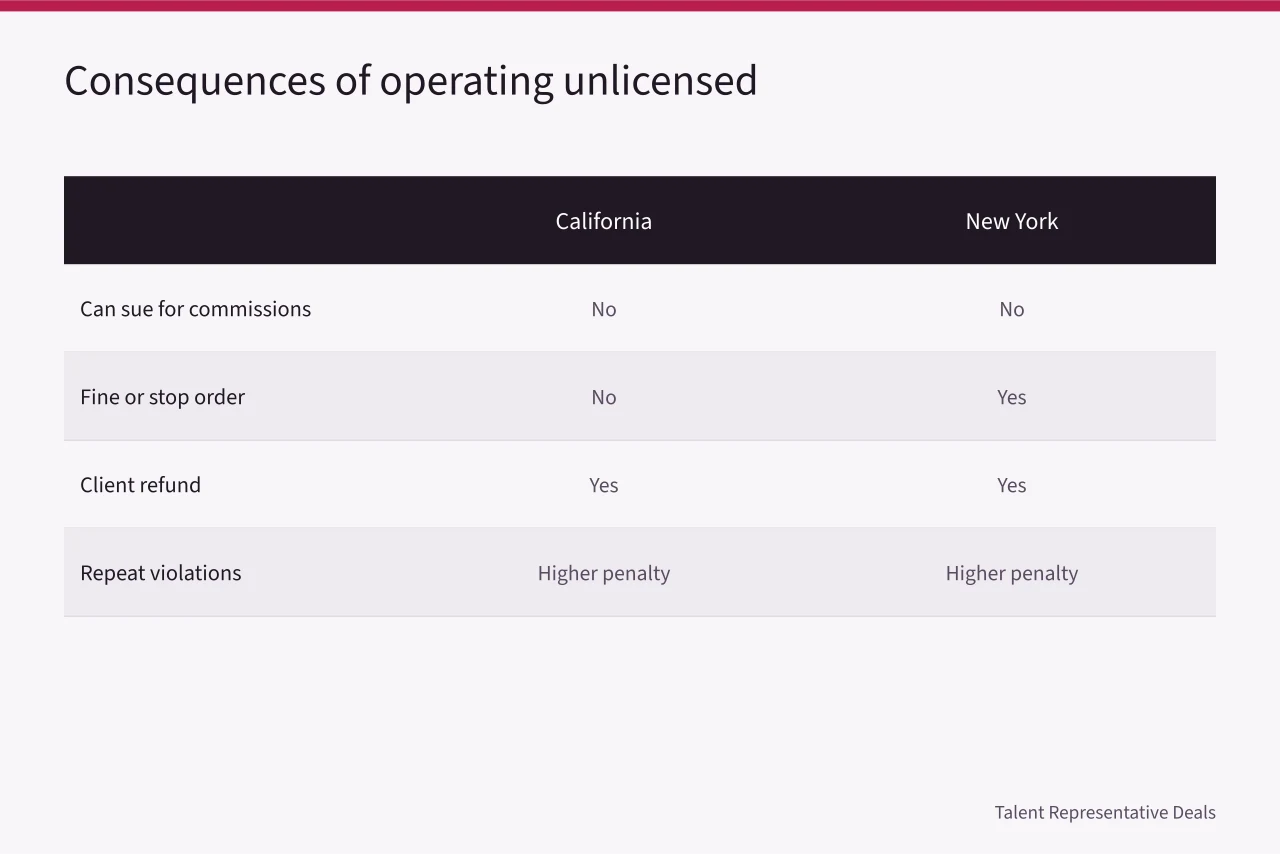
New York can fine an unlicensed agency and order it to stop operating. Repeat violations raise the penalty. The city can also refuse to renew.
There is a slower cost. Deals signed under an invalid contract get unwound months later, after the brand has paid and the creator has spent. That is the part nobody mentions until afterwards. For how these failures show up in client rosters, read why clients leave after onboarding.
Where the rules differ by place
The patchwork is the point. Three patterns cover most of the country.
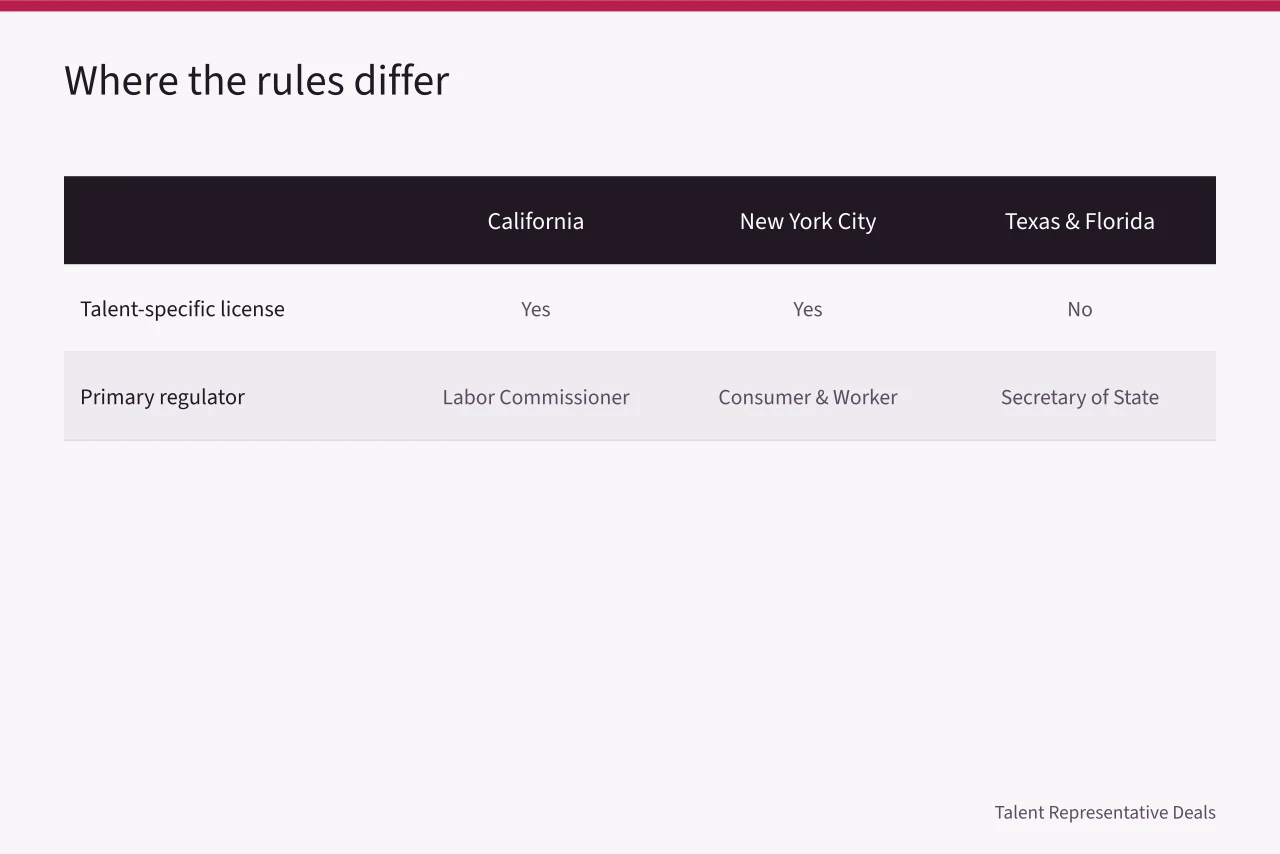
| Place | Talent-specific license | Primary regulator |
|---|---|---|
| California | Yes | Labor Commissioner, DIR |
| New York City | Yes | Dept. of Consumer and Worker Protection |
| Texas, Florida | No | Secretary of State, general business |
| Most other states | No | Secretary of State, general business |
If you sign creators in several states, build the filing sequence into your calendar before the first contract. A compliance calendar keeps renewals from slipping. See how to build a US compliance calendar.
Start with the SBA guide on applying for licenses and permits to map state-level steps. Then confirm your state's business filing through the IRS list of state government websites.
If your roster includes Canadian creators, the cross-border picture adds another layer. Review cross-border representation rules before you sign.
Example
A two-person agency opens in Los Angeles and signs three creators in one month. It registers an LLC, gets an EIN and opens a bank account. It does not file with the Labor Commissioner.
Six months later, a brand deal falls apart and the agency tries to collect its 20 percent. The creator's lawyer points to the missing license. The contract is unenforceable, and the agency refunds commissions already paid. Total loss: the commissions plus legal fees.
Common questions
Do I need a license in every state where a client lives? No. The trigger is where you procure employment, not where the creator resides. California and New York City are the two places that most often require a talent-specific filing.
How long does a California talent agency license take? Timelines vary by workload and completeness of the application. Filing early matters more than any single estimate, because you cannot legally procure work while the application is pending.
Does an LLC registration count as a talent agency license? No. An LLC filing is a general business registration. California and New York City require a separate talent or employment agency license on top of it.
What if I only manage brand deals and never book auditions? The line is procurement. If you negotiate or arrange paid engagements for a client, most regulators treat that as agency activity regardless of the deal type.