Guides
GST/HST on talent agency commissions: what to charge Canadian clients
GST/HST on talent agency commissions: compare staying a small supplier, registering voluntarily, or charging once mandatory. Rates by province and CAD examples.
What to take away
- A talent agency stays a small supplier until its taxable revenues exceed CAD 30,000 over four consecutive calendar quarters.
- Voluntary GST/HST registration is allowed below that threshold, but you must charge tax on Canadian commissions from the effective date.
- Charge 5 percent GST in a non-HST province and 13 or 15 percent HST where HST applies, based on the province where the supply is made.
- Include your GST/HST registration number on every taxable invoice and keep place-of-supply records for clients outside Canada.
What is being compared
This page compares GST/HST on talent agency commissions: what to charge Canadian clients. Three positions exist: remain an unregistered small supplier, register voluntarily, or register because it is mandatory. The comparison is not about whether the work is taxable. A commission on talent or influencer services is a taxable supply for GST/HST purposes when supplied in Canada.
The criteria that matter
The decision turns on five criteria: registration trigger, rate collected, input tax credit availability, client-facing invoice effect, and administrative burden.
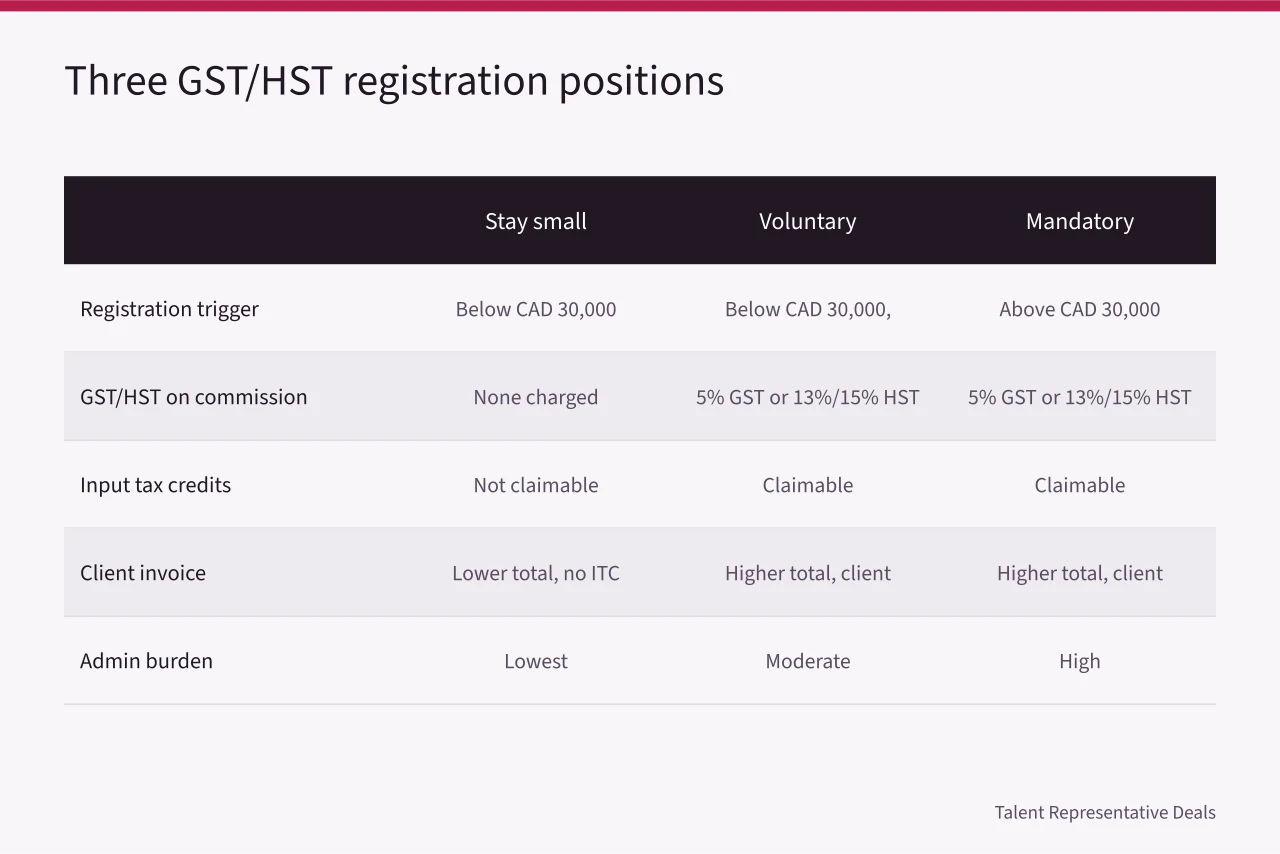
| Criterion | Stay small supplier | Voluntary registrant | Mandatory registrant |
|---|---|---|---|
| Registration trigger | Below CAD 30,000 in last four quarters | Below CAD 30,000 but elects to register | Above CAD 30,000 |
| GST/HST on Canadian commission | None charged | 5% GST or 13%/15% HST | 5% GST or 13%/15% HST |
| Input tax credits on expenses | Not claimable | Claimable | Claimable |
| Client-facing invoice | Lower total, but client cannot claim ITC | Higher total, client may claim ITC if registered | Higher total, client may claim ITC if registered |
| Administrative burden | Lowest | Moderate | High |
Option by option
Stay small supplier. This works for a new agency with low Canadian revenue and few taxable purchases. The agency does not charge GST/HST, so its price to clients is lower on the invoice. The trade-off is clear: it cannot recover the GST/HST built into its own rent, software, or travel. Keep a rolling four-quarter revenue tally. Once you exceed CAD 30,000, you must register right away.
Voluntary registrant. An agency can register even below the threshold. This lets you claim input tax credits on expenses like office space, equipment, and software. You must then charge GST/HST on taxable commissions. This often makes sense when the agency has more taxable inputs than taxable sales early on. A voluntary registrant files regular returns and carries the same paperwork as a larger agency.
Mandatory registrant. Once revenue passes the threshold, the choice disappears. The agency must charge, collect, and remit. Failure to register and collect can lead to assessment for uncollected tax plus interest and penalties. This option has no decision, but the correct rate still matters. Commission collection timing is broader than tax registration; see collecting agency commission.
How to charge Canadian clients
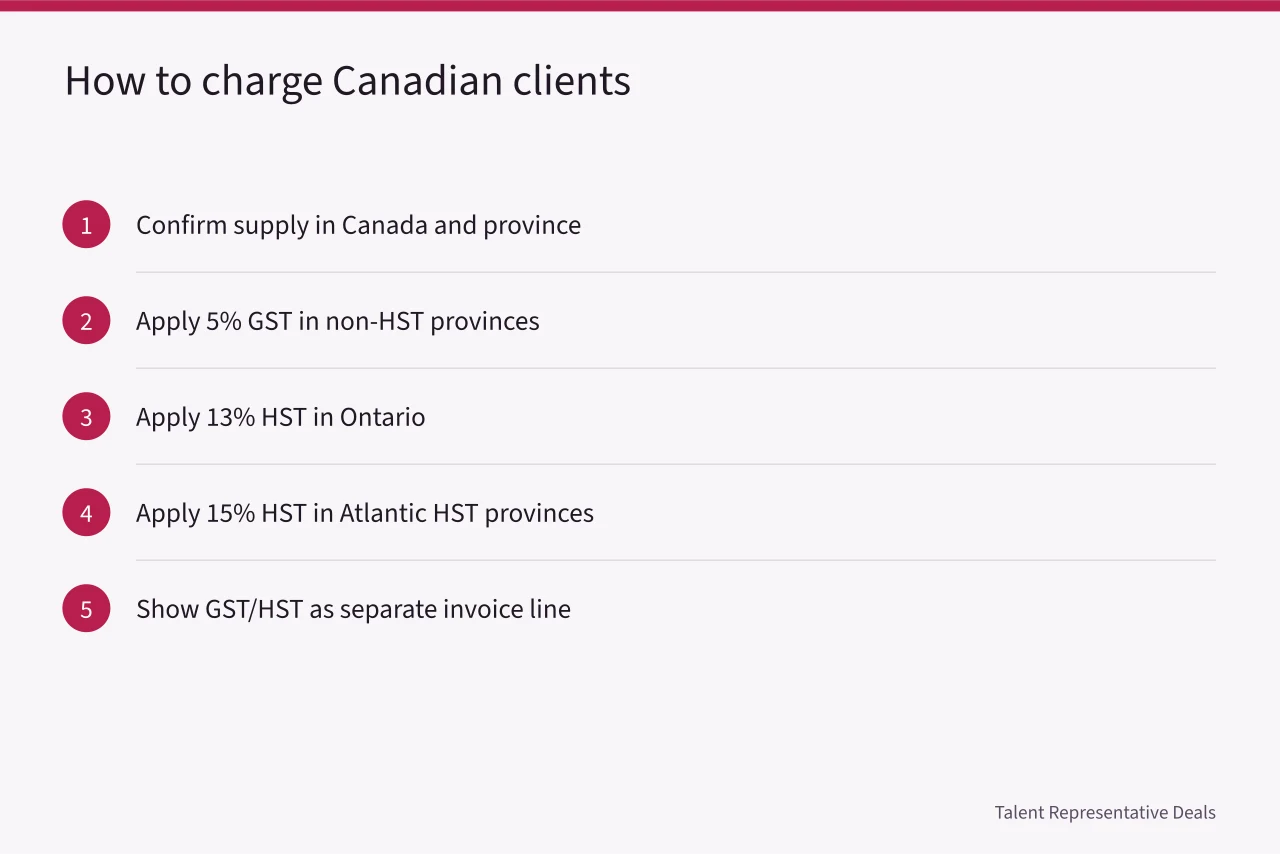
- Confirm whether the supply is made in Canada and which province applies.
- Apply 5 percent GST in non-HST provinces and territories. Examples include Alberta, British Columbia, and Quebec.
- Apply 13 percent HST in Ontario.
- Apply 15 percent HST in Nova Scotia, New Brunswick, Newfoundland and Labrador, or Prince Edward Island.
- Show the GST/HST amount as a separate line on the invoice with your registration number.
Quebec also imposes QST, which is separate from GST and not part of this CRA guide.
Example: commission on a Toronto deal
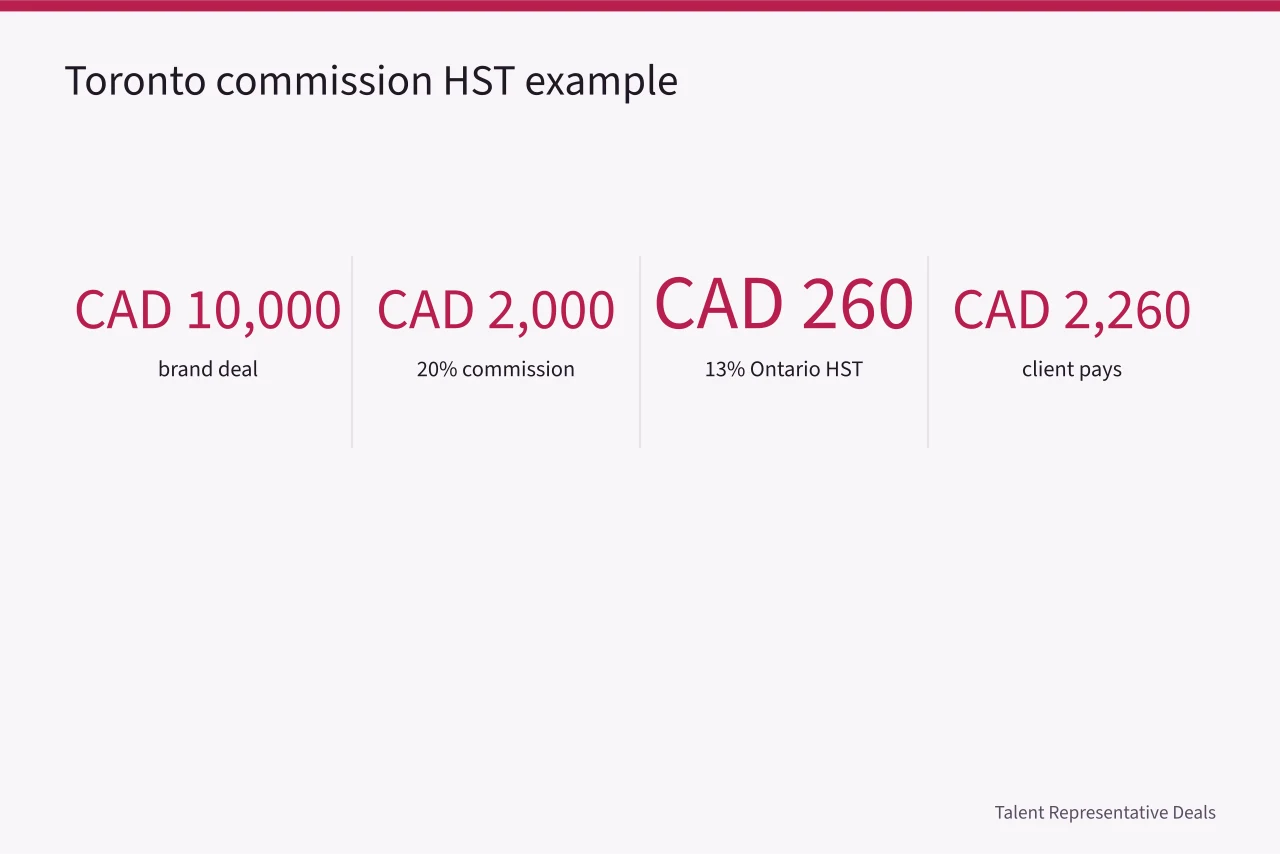
A Toronto agency charges a 20 percent commission on a CAD 10,000 brand deal. The commission is CAD 2,000. Because the supply is made in Ontario, the agency adds 13 percent HST: CAD 260. The client pays CAD 2,260. The agency remits the CAD 260 on its next HST return.
Where each one wins
A small supplier wins when the agency has almost no taxable expenses and wants the lowest upfront client price. Voluntary registration wins when the agency pays GST/HST on rent, software, or equipment and can recover those amounts. Mandatory registration wins in the sense that once required, the agency can claim input tax credits and presents the same taxed invoice as established firms, which clients already expect.
What none of them solve
All three options share a limitation: none settles provincial sales tax outside the GST/HST system. Quebec clients may trigger QST registration with Revenu Québec. None of these positions settles provincial employment or licensing rules. Ontario's Employment Standards Act can require a talent agency licence, separate from any GST/HST obligation. None of them removes the need to track place-of-supply proof when the client is outside Canada. An export may be zero-rated but still needs records. Brand deals themselves have disclosure rules that run alongside tax invoices; see Canadian influencer marketing disclosure rules.
Common questions
Does a talent agency always charge GST/HST on its commission? No. If the agency is a small supplier and not voluntarily registered, it does not charge GST/HST. If the agency is registered, it charges GST or HST on taxable commissions supplied in Canada.
What happens if I exceed the CAD 30,000 threshold mid-year? You stop being a small supplier and must register. You must start charging GST/HST on taxable supplies from the date you are no longer a small supplier.
Do I charge HST based on my province or the client's province? In most cases, the rate reflects the province where the supply is made. For many agency services, that is the province where the service is performed. Check the CRA guide when the client is located elsewhere.
What about Quebec clients? You may need to register for QST with Revenu Québec in addition to GST. If you also translate documents for Quebec clients, see Quebec language law for influencer contracts.