Guides
How to price influencer brand deal usage rights for an agency
Influencer brand deal usage rights pricing spans $250 for a 30-day paid boost to $25,000 or more for perpetual worldwide rights, with rates rising for exclusivity.
What to take away
- Usage rights are a separate line item from the creator fee. A 30-day paid social license runs roughly $250 to $1,500; perpetual worldwide rights can reach $25,000 or more on the same shoot.
- Agencies that fold usage into the base fee give away the most expensive part of the deal. Price it as its own line.
- Duration and territory drive the number more than impressions do. A one-year US license is not a perpetual global license.
- Whiteness and exclusivity are recurring costs, not one-offs. Charge them monthly or they compound against you.
Usage rights are where a brand deal quietly doubles in value and the agency still invoices the original number. The creator delivers one set of assets; the brand wants to run them as paid ads, on its own channels, in email, and possibly forever. Each of those is a separate grant under US copyright law, and each has a price.
The U.S. Copyright Office sets out the exclusive rights a creator holds by default, including reproduction, distribution, and public display. A license transfers only what the contract names. Read Copyright Office Circular 1 before you quote a number, because the scope you write is the scope you can bill.
What the range covers
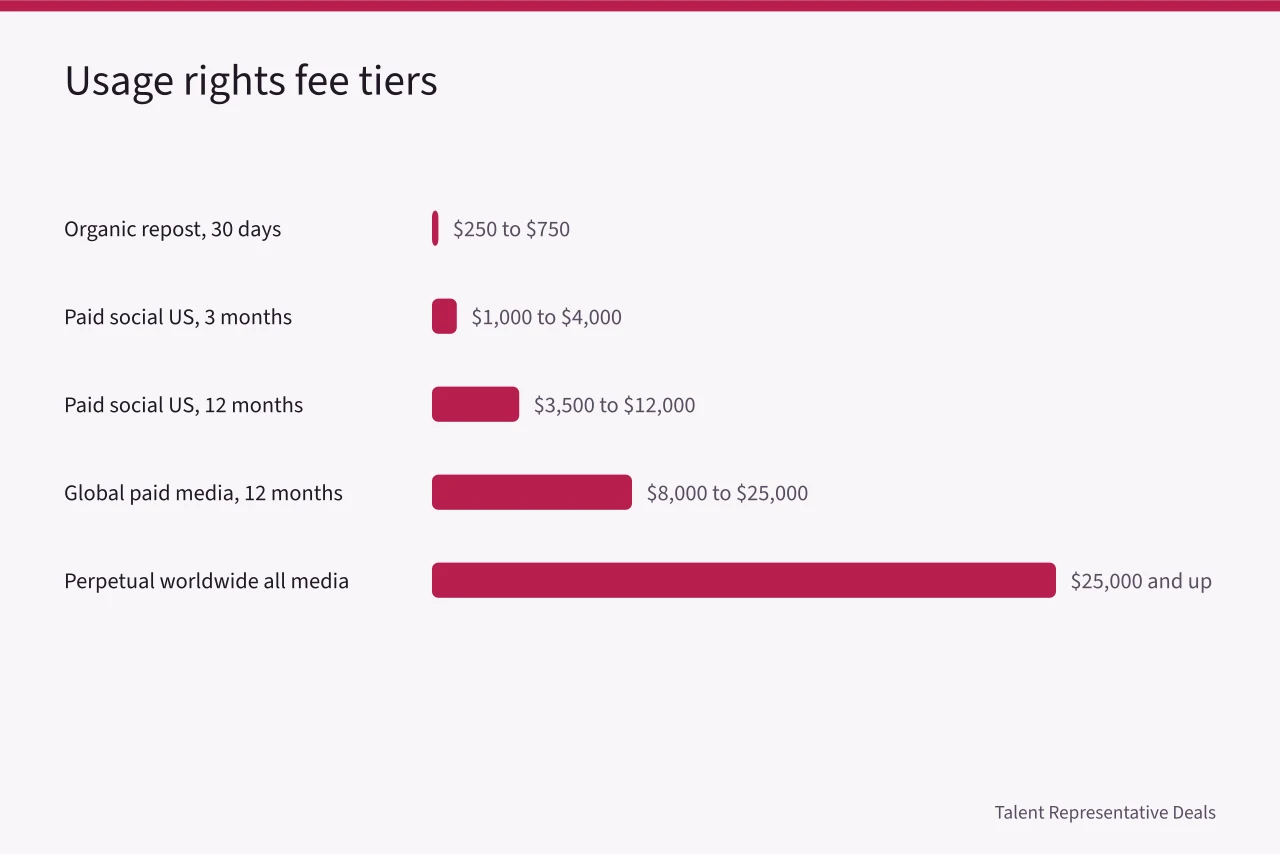
The table below shows illustrative US agency quotes for one creator with roughly 250,000 followers on Instagram and TikTok. Figures are ranges, not benchmarks.
| Usage tier | Typical fee (USD) |
|---|---|
| Organic repost on brand channels, 30 days | $250 to $750 |
| Paid social license, US, 3 months | $1,000 to $4,000 |
| Paid social license, US, 12 months | $3,500 to $12,000 |
| Global paid media, 12 months | $8,000 to $25,000 |
| Perpetual, worldwide, all media | $25,000 and up |
A perpetual grant is the most expensive thing an agency can sell and the easiest to give away by accident. If the contract says "in perpetuity" without a media list, the brand can use the footage in a Super Bowl spot and pay nothing more.
Line by line
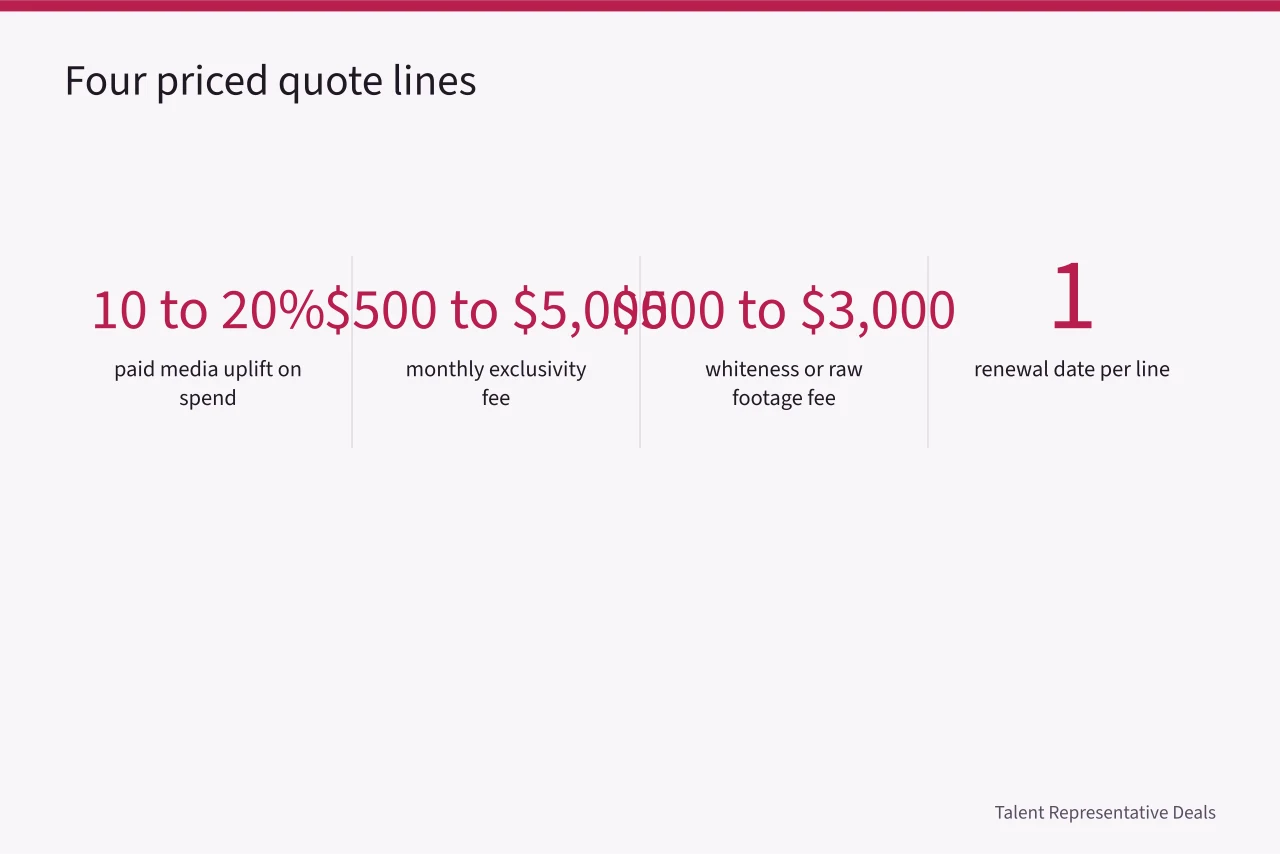
A complete usage quote has four priced pieces.
- Base license: the duration and territory you name, quoted as a flat fee.
- Paid media uplift: a percentage of media spend, often 10 to 20 percent, when the brand puts money behind the asset.
- Exclusivity: a monthly fee that keeps the creator out of a competitor category, commonly $500 to $5,000 per month depending on tier.
- Whiteness or raw footage: a one-off fee, usually $500 to $3,000, for assets the creator would not otherwise hand over.
Each line needs its own renewal date. A brand that renews after month twelve should pay again, not continue on the original invoice.
Fixed against variable
The base license is a one-off. It is tied to a defined term and a defined territory, and it ends. Everything attached to performance is recurring: media spend percentages, exclusivity retainers, and option renewals.
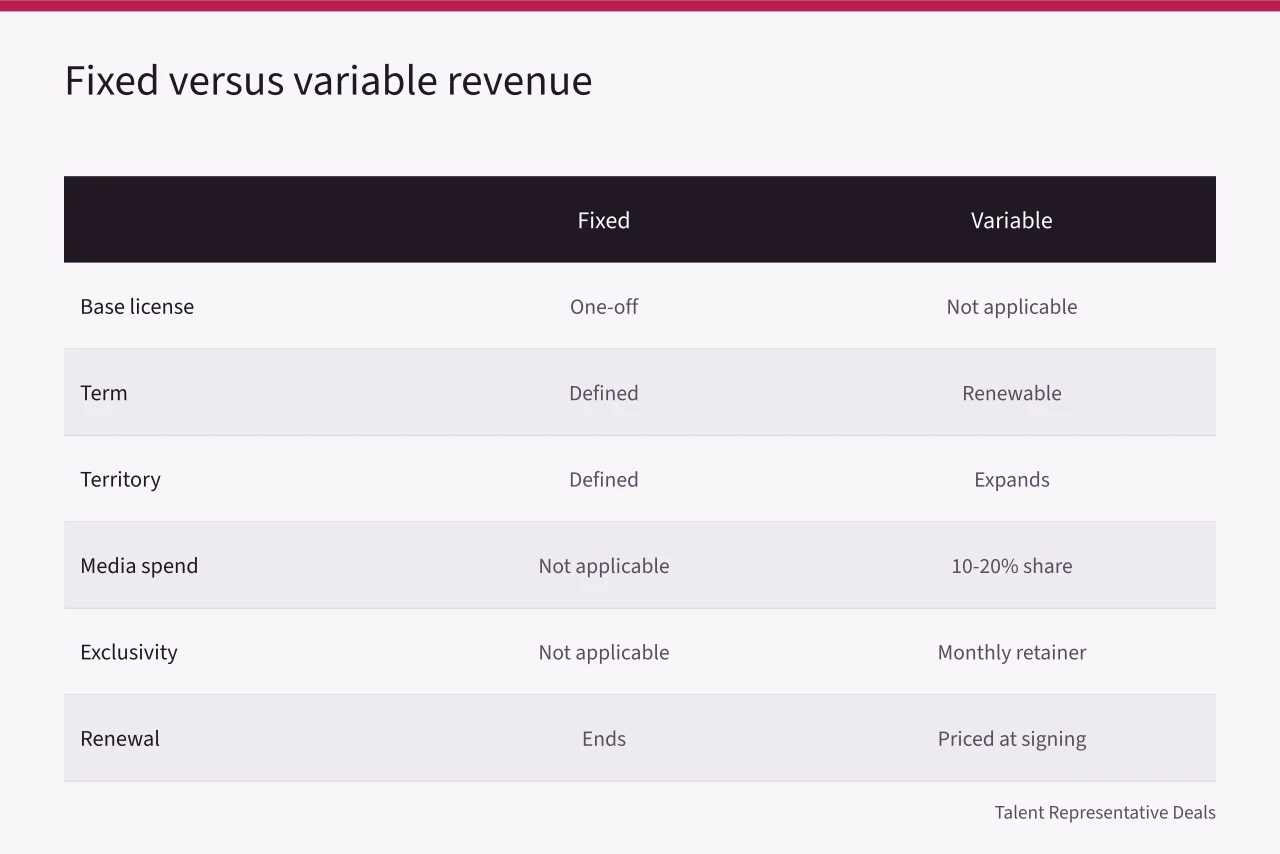
Agencies that quote only the one-off number lose the recurring revenue. A brand that spends $200,000 on paid media behind a licensed asset owes the creator a share of that spend under a well-drafted uplift clause. Without the clause, the creator gets the flat fee and nothing else.
Set the renewal price at signing. If the contract is silent, the brand will assume the original fee still applies, and you will spend a month arguing about it. The same discipline applies to contract terms a talent agency should never leave out, where usage language is often the first thing dropped in a redline.
What the tools do not include
Contract templates and rights-management software price nothing for you. They store the terms you wrote. If the term says "digital" and the brand later wants out-of-home, the template will not tell you what that costs.
Two costs sit outside the usage line entirely. Errors and omissions insurance premiums rise with the breadth of the grants you sign, and the general overview of errors and omissions insurance explains why defense costs, not just liability, move the premium. Second, FTC disclosure obligations travel with every use of the asset, including paid amplification, as the FTC's Disclosures 101 for Social Media Influencers makes clear.
Where budgets leak
Leaks cluster in three places.
- The contract defines "term" but not the start date, so the brand argues the clock began at delivery.
- Territory is written as "worldwide" because nobody asked, and the creator loses the ability to resell the same assets in Europe.
- Exclusivity is granted for free as a goodwill gesture on the first deal, then becomes the expected baseline.
A fourth leak is internal: the account manager who negotiated the deal leaves, and the renewal calendar leaves with them. Track usage expiry the same way you track client churn warning signs, because a lapsed renewal looks identical to a lost client until you check the contract.
A usage grant with no end date is a sale, not a license. Price it like one.
Example
A skincare brand offers a creator $6,000 for one Instagram Reel and asks for "full rights" in the reply email. The agency quotes $6,000 for the post plus $2,500 for a 90-day US paid social license, $1,500 per month for category exclusivity, and a 15 percent share of media spend above $50,000. The brand counters at $9,000 all-in. The agency holds the media spend clause and drops exclusivity to three months, closing at $11,500 with a renewal option at 110 percent of the original license fee.
The difference between $6,000 and $11,500 is not negotiation skill. It is a line-item quote and a renewal clause.
Common questions
Is a usage fee taxable as commission?
It depends on how the agency is paid. A flat licensing fee routed to the creator is generally not commission, while an agency percentage of that fee may be. The Cornell Wex definition of commission covers the general principles, and your accountant should confirm treatment state by state.
How long should a standard paid social license run?
Ninety days is the common starting point in US brand deals. Twelve months is a different product at a materially higher price, and perpetual worldwide rights sit at the top of the range.
Can a brand reuse assets after the term ends?
Not without a new grant. Once the license expires, continued use is infringement unless the contract says otherwise, which is why renewal pricing belongs in the original agreement.
Does the creator keep the raw footage?
By default, yes. Handing over raw files is a separate grant, and it should carry a separate fee.