Guides
Actors by era facts, tested against experience
Actors by era facts: what agents and managers really do, how each is paid, and the plain test that separates real representation from an operation selling hope.
Representation is the part of the business that outsiders understand least and that costs them the most. Twenty one plain points about what agents and managers do, how they are paid, and how to tell a real one from an operation that lives off hopeful people.
What to take away
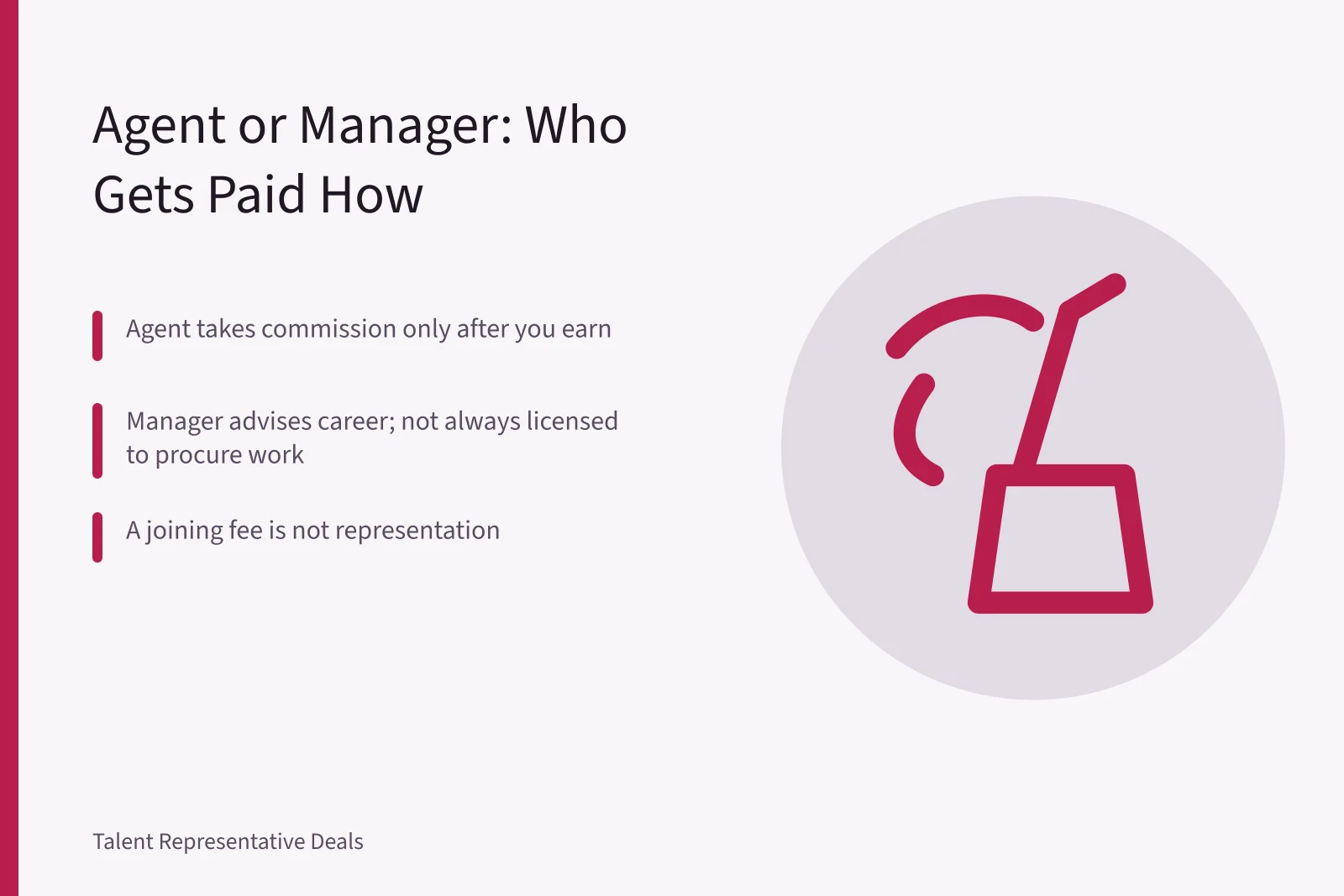
- An agent is paid a percentage of what you actually earn, after you earn it. Never in advance.
- A manager advises and develops a career over time. A manager is not a substitute for an agent, and in many places is not licensed to procure work.
- Any company that charges you to be represented, submitted, photographed or trained as a condition of signing is selling you something other than representation.
Twenty one points
- An agent's job is to get you seensubmissions, relationships with casting offices, and negotiation once an offer exists.
- An agent is paid commission on money you receive from work they are entitled to commission. No booking, no fee.
- Commission rates vary by country and by contract type, so read the figure in your own agreement rather than assuming a standard.
- A manager's job is longer term: career strategy, choices between offers, introductions, and sometimes help with materials.
- Managers usually take a percentage too, and it is normal for both to be paid on the same job.
- In some jurisdictions only a licensed agency may solicit employment for a performer, and a manager doing so is acting outside the rules.
- Check whether your jurisdiction licenses talent agencies, and check the license. That register is public where it exists.
- A legitimate agency's income depends on you working, which is why they are selective. Selectivity is a feature, not rudeness.
- An agency that signs everybody is not making money from bookings. Ask yourself where its income comes from.
- Upfront fees, registration fees, annual membership fees and compulsory administration charges are the classic pay to play pattern.
- So is a requirement to use one named photographer, one named class, or one named reel editor. The referral is usually the product.
- A free consultation that ends with an urgent payment deadline is a sales technique, not an offer of representation.
- Praise you did not earn is a warning. Real interest sounds like specific casting thinking, not flattery.
- Read the whole contract, including its length, its exclusivity, its termination clause and what happens to work you found yourself.
- Ask how many performers of your type and age range are on the list. Too many means you are competing inside your own agency.
- Ask which casting offices they submit to and which projects their clients booked recently. Vagueness is an answer.
- Get every important agreement in writing, including who commissions what, and keep your own copy.
- You may leave an agency. Notice periods and post termination commission on work already booked are normal, so know the terms before signing.
- Representation does not create work. It creates access to submissions, and the auditions still have to be won.
- Plenty of performers work without an agent for years by self submitting where that is possible, and this is a legitimate route rather than a failure.
- For a performer under eighteen, an adult is legally involved in every one of these decisions, and the protections that exist are there for good reasons.
The test that settles most cases
Legitimate answer
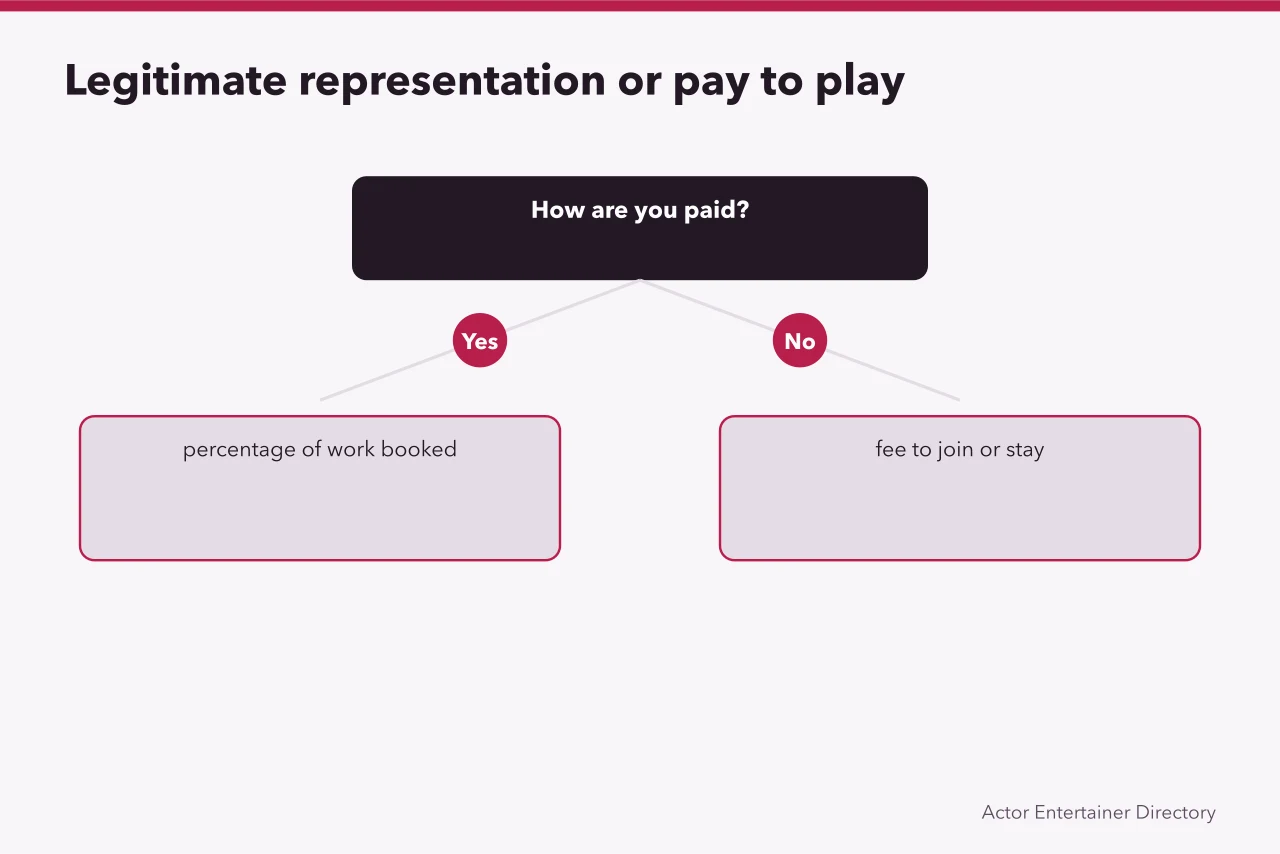
- How are you paid?
- A percentage of work I book
- Can I use my own photographer?
- Yes, if the pictures are good enough
- What have your clients done?
- Named, checkable productions
- Are you licensed here?
- Yes, and here is the register
- May I take the contract away?
- Of course
What should stop you
- How are you paid?
- A fee to join, or to stay on the books
- Can I use my own photographer?
- Only ours, at our price
- What have your clients done?
- Impressive sounding but unnamed work
- Are you licensed here?
- The question is treated as an insult
- May I take the contract away?
- Sign today or the offer closes
Money moving from you to a representative before you have earned anything is the line. If that line is crossed, nothing else about the pitch matters.
Before you sign anything
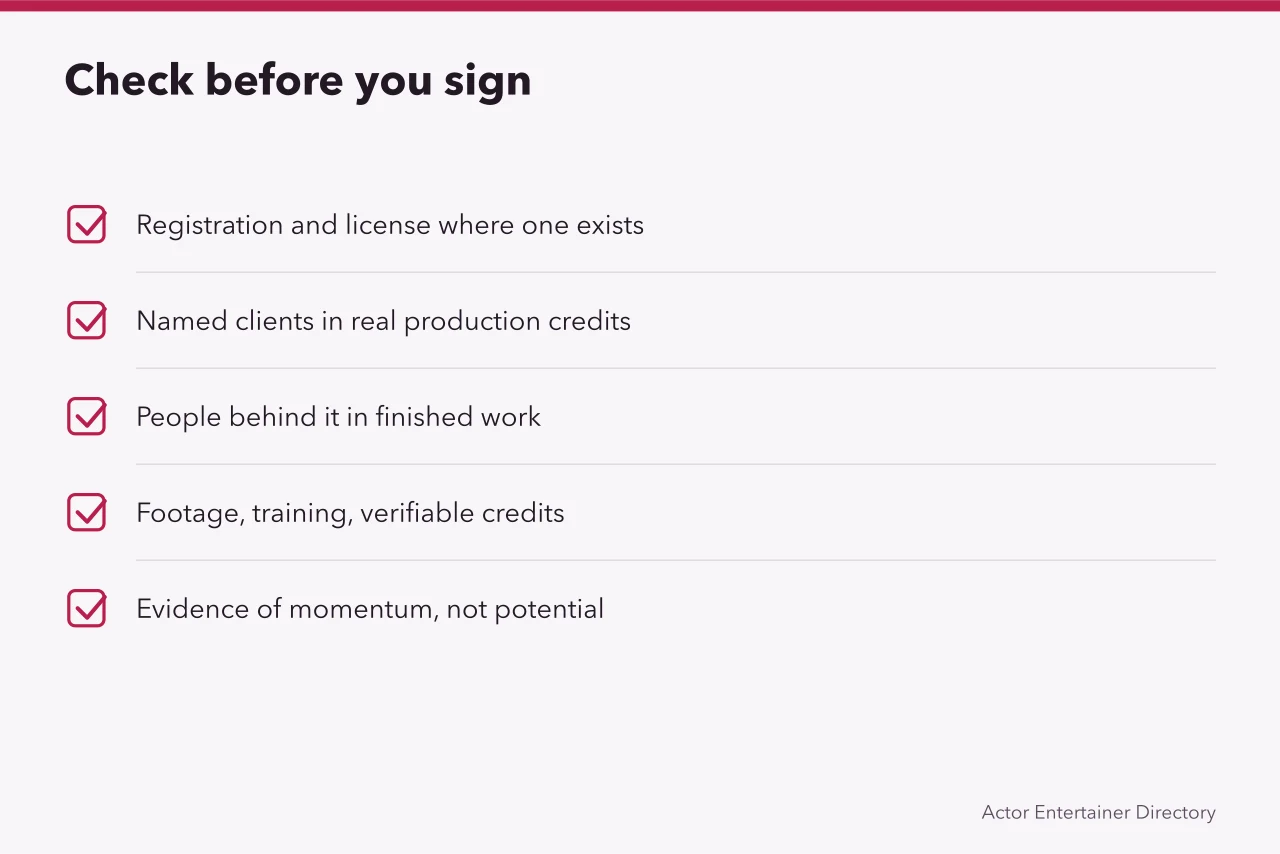
Check the company as you would any unknown employer. Look for registration, the license where one exists, named clients in the credits of real productions, and the people behind it in the record of finished work.
The full routine is the same one used to check that a project or company is real. Run it even when an approach comes with a recommendation.
Then be honest about timing. Representation is easier to get once you have something to represent: footage, training, and a few credits somebody else can verify. Reading how work arrives in clusters explains why agents look for evidence of momentum rather than potential.
Common questions
Do I need a manager and an agent?
Most performers need an agent long before they need a manager. A manager makes sense when there are enough decisions to manage.
Can an agency ask me to pay for a website or a profile?
Be careful. Some ordinary costs exist in this business, but a charge that is a condition of representation is not one of them. Keep control of what you buy and from whom.
What if a company offering representation approaches a child?
Slow everything down. The rules protecting young performers exist because this is where the pressure is worst, and the notes on child actors are worth reading before any meeting.
Where do I start reading about the wider picture?
The overview of actors by era and the general guide to film actors both give context for how hiring works, which is what representation plugs into rather than replaces.