Guides
How to shortlist talent agencies, and what to judge them on
How to choose a talent agency for a casting: matching the shop to the shape of the brief, testing roster claims, and cutting to two on quotes for identical terms.
A ranked list of talent agencies would be worthless, even if someone could produce one honestly.
You are not buying a company. You are buying access to a specific group of people for a specific piece of work. The agency that fits a single hero partnership is wrong for a campaign built from twenty mid-sized creators.
The useful question is which shape of representation your brief needs, and then which two candidates can prove they have it.
What to take away
- Match the agency to the shape of the casting, not to its reputation. The shapes have different economics and different failure points.
- A roster claim is testable in one afternoon. Test it before the pitch rather than after the contract.
- Shortlist to two, and make the deciding evidence a real quote on real terms rather than a deck.
Four casting shapes and what each one needs
What the agency has to be good at
- One long-term partner for the brand
- Career judgment, conflict management, appetite for a multi-year structure
- A burst of twenty mid-sized creators
- Coordination, paperwork at volume, dependable scheduling
- A category-restricted brief, where most creators are ineligible
- Knowing the restrictions before you explain them, and screening against them
- A market you do not operate in yet
- Local relationships and local contract practice
What matters less than you think
- One long-term partner for the brand
- Volume, and the size of the roster
- A burst of twenty mid-sized creators
- Star power, and named individual attention
- A category-restricted brief, where most creators are ineligible
- Breadth of categories they also cover
- A market you do not operate in yet
- Everything else on this list
The last row is the one people underrate. In an unfamiliar market, local relationships are worth more than any index subscription you could buy instead, a trade-off set out in the guide to creator discovery tools.
Two agencies can both be excellent and be built for different rows of that table. The mismatch shows up late, usually as slowness: a relationship-led shop asked to deliver at volume, or a coordination-led one asked to hold a delicate partnership together.
A roster is a catalog, and the useful question about any catalog is the same: who decided what goes in it, and on what basis.
The claims worth testing before a pitch
Every pitch contains three claims. All three can be checked cheaply, and checking them is due diligence rather than suspicion.
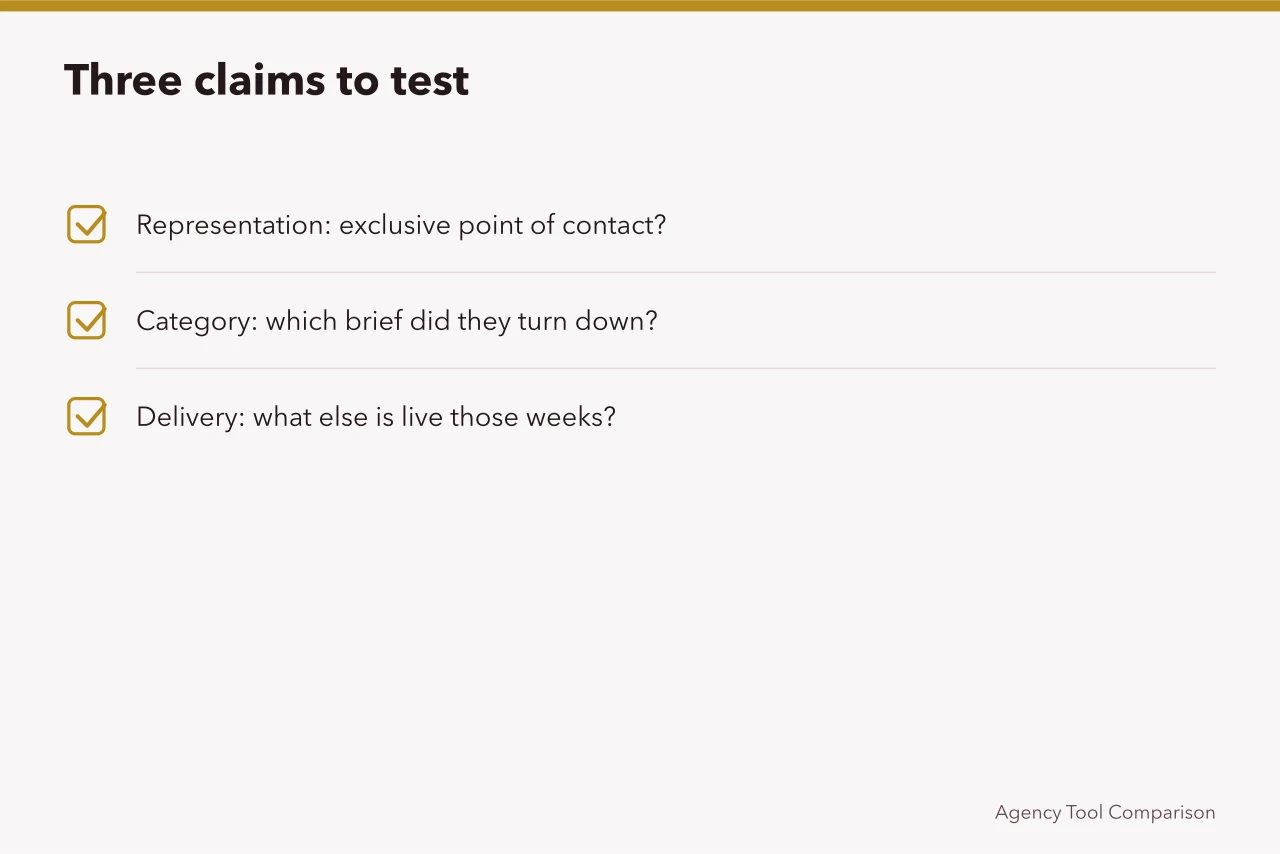
We represent these creators. Representation runs from exclusive to a loose arrangement where the agency can offer you an introduction and little else. Pick three names from the deck and ask, in writing, whether the agency is the exclusive point of contact for each, and what happens if a creator leaves mid-campaign. Exclusive representation is a form of exclusive dealing, and it is either in place or it is not.
We have worked in your category. Ask which brief in that category they turned down and why. A shop with real category experience has refused work in it. One that has only sold into it will describe wins.
We can deliver in that window. Ask what else is live in the same weeks and who would be handling your account alongside it. Availability is the constraint nobody puts in a deck, and it is the one that decides whether your dates hold.
What actually separates two good candidates
Once the obvious weak candidates are gone, the deciding differences are unglamorous.
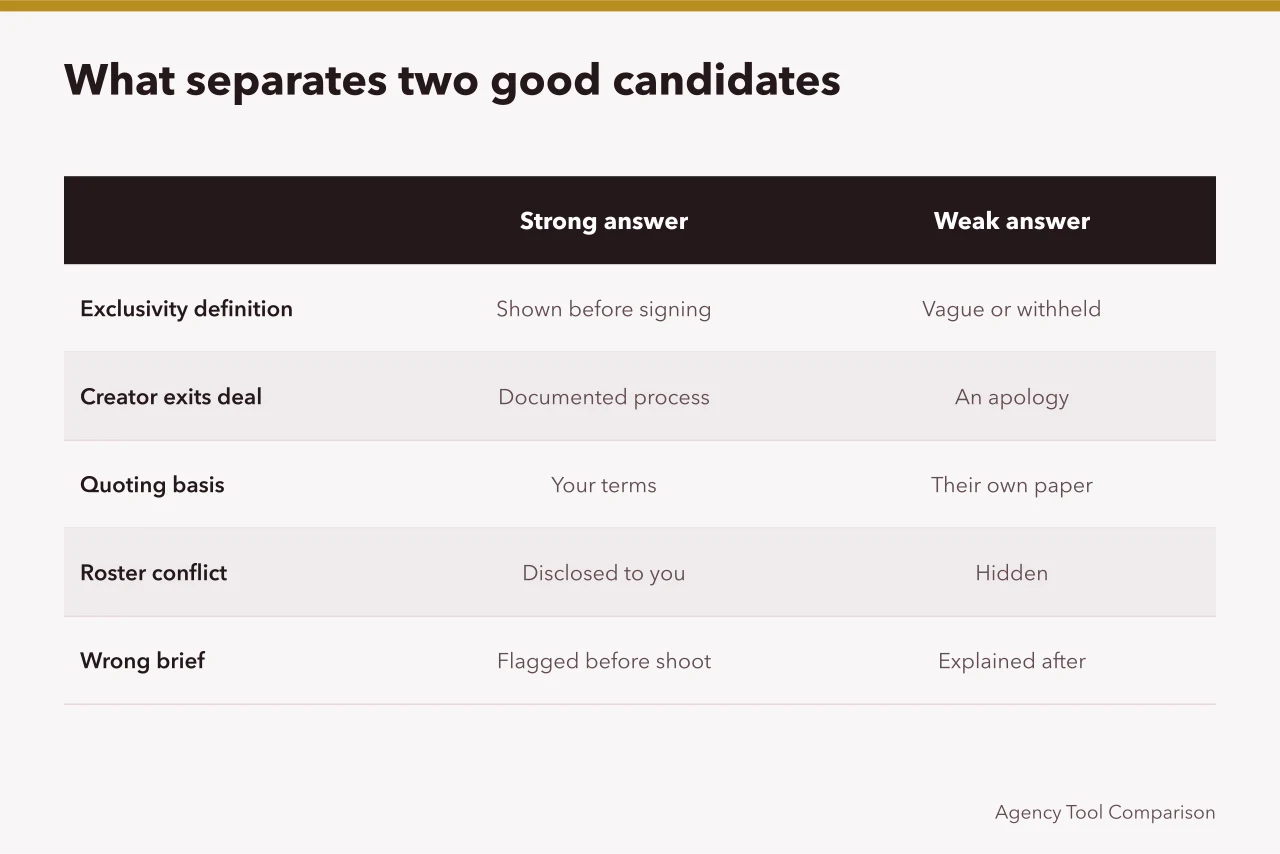
None of these appear in a credentials deck. All of them appear in a quote and a first negotiation, which is why the shortlist should end with a real request rather than a beauty parade. Holding that request to one set of terms, so the replies can be read side by side, is the whole of structured vendor comparison.
Write the usage, the exclusivity and the dates into the request itself, or the replies will price different bundles and compare as nonsense.
Running the shortlist down to two
Start wide and cut on evidence rather than impression.
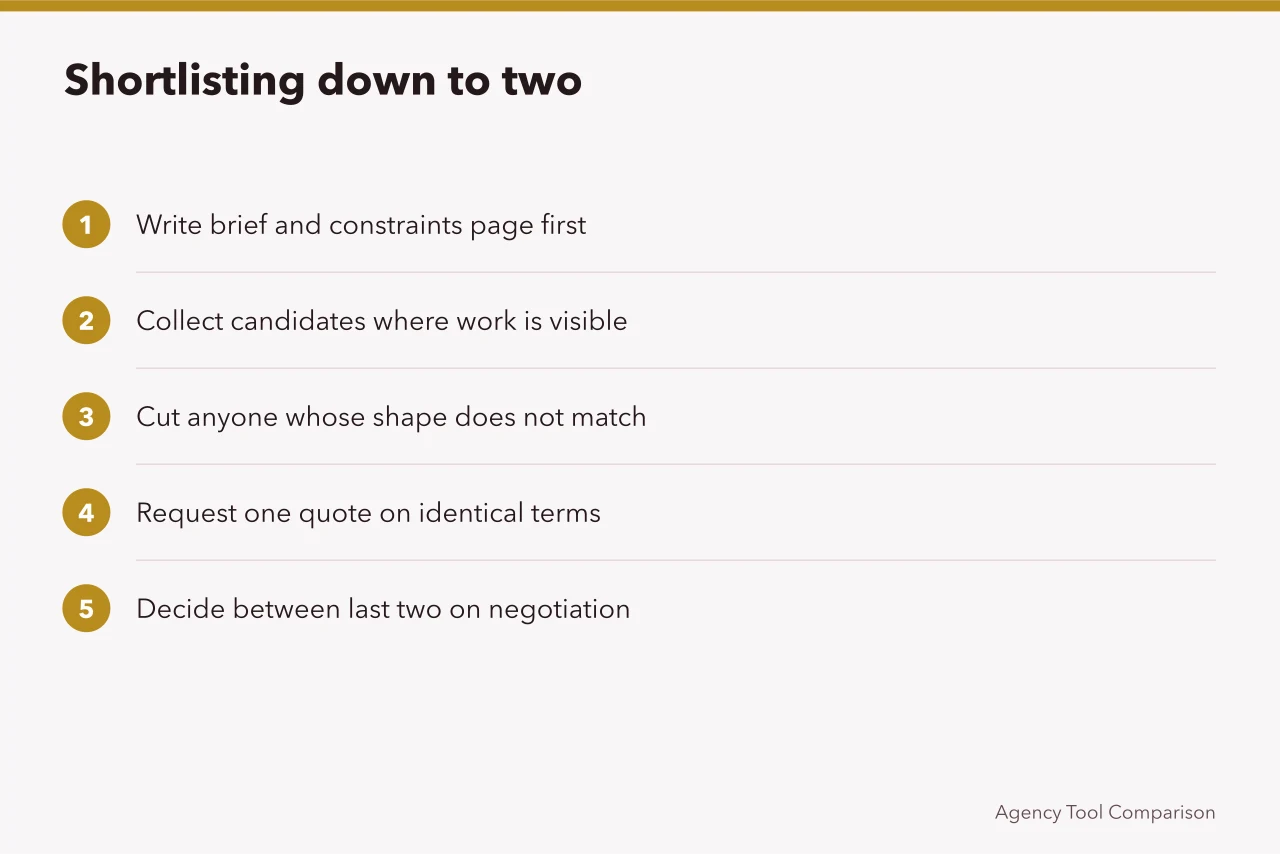
If you find yourself with five finalists, the brief is not specific enough to separate them. That is a signal to go back to the brief rather than to build a scoring matrix.
Where representation is not the answer
Some briefs do not need an agency at all. Work that is genuinely transactional, where you want a defined output from a known format and no ongoing relationship, is often faster to buy through a creator marketplace, and the commission on a represented deal buys you nothing you need.
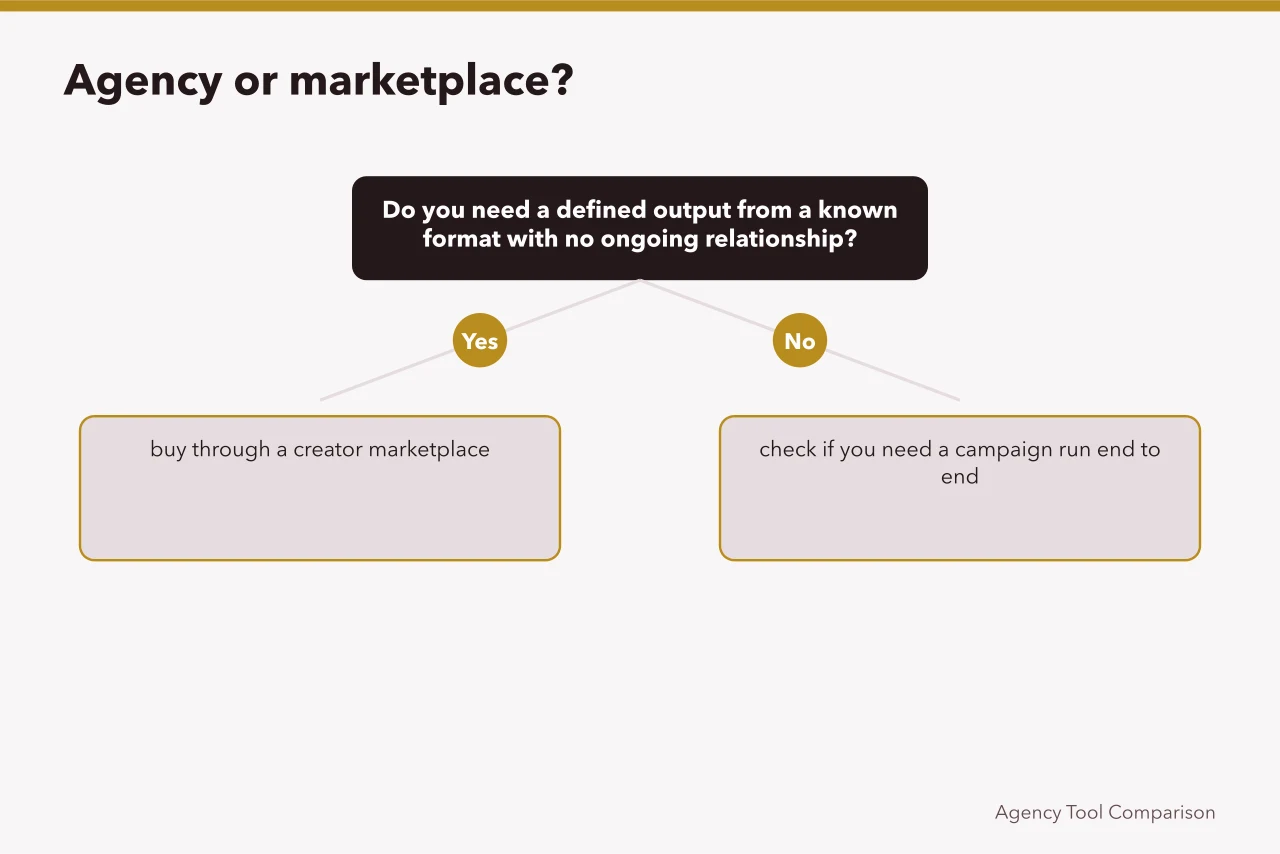
The reverse case matters too. If what you want is a campaign run end to end, with strategy, sourcing, briefing and reporting, that is a different purchase from representation. Buying representation when you needed an operator is a common and expensive confusion, because an agency that works for the creator will not run your process for you.
Common questions
Is a boutique better than a large agency?
For attention, usually. For range and for covering a market you do not know, usually not. The honest version of the question is whether your account would be interesting to the agency you are choosing, and a small account at a large shop rarely is.
Should we pay a retainer to a talent agency?
Be careful about what it buys. Representation is paid by the creator, so a retainer from you is paying for something else: priority, first look, or a service the agency has added. Ask which, and get it defined, or you are paying for goodwill.
How much does an agency's reputation matter?
It predicts how creators treat them, which affects whether your dates hold. It predicts very little about how they will treat you.
Can we run a paid trial before committing?
Yes, and one real small campaign teaches you more than any number of meetings. Keep it real enough to hit a problem: a live date, a genuine approval chain, and a payment at the end.